

The search term “easyJet flight U2238 emergency landing Newcastle” refers to an easyJet flight that diverted to Newcastle International Airport on 27 October 2025 after a passenger required urgent medical assistance. However, an important flight-number correction is needed: the aircraft involved was U2 2238, commonly written U22238 or EZY2238, rather than the separate U2238 service.
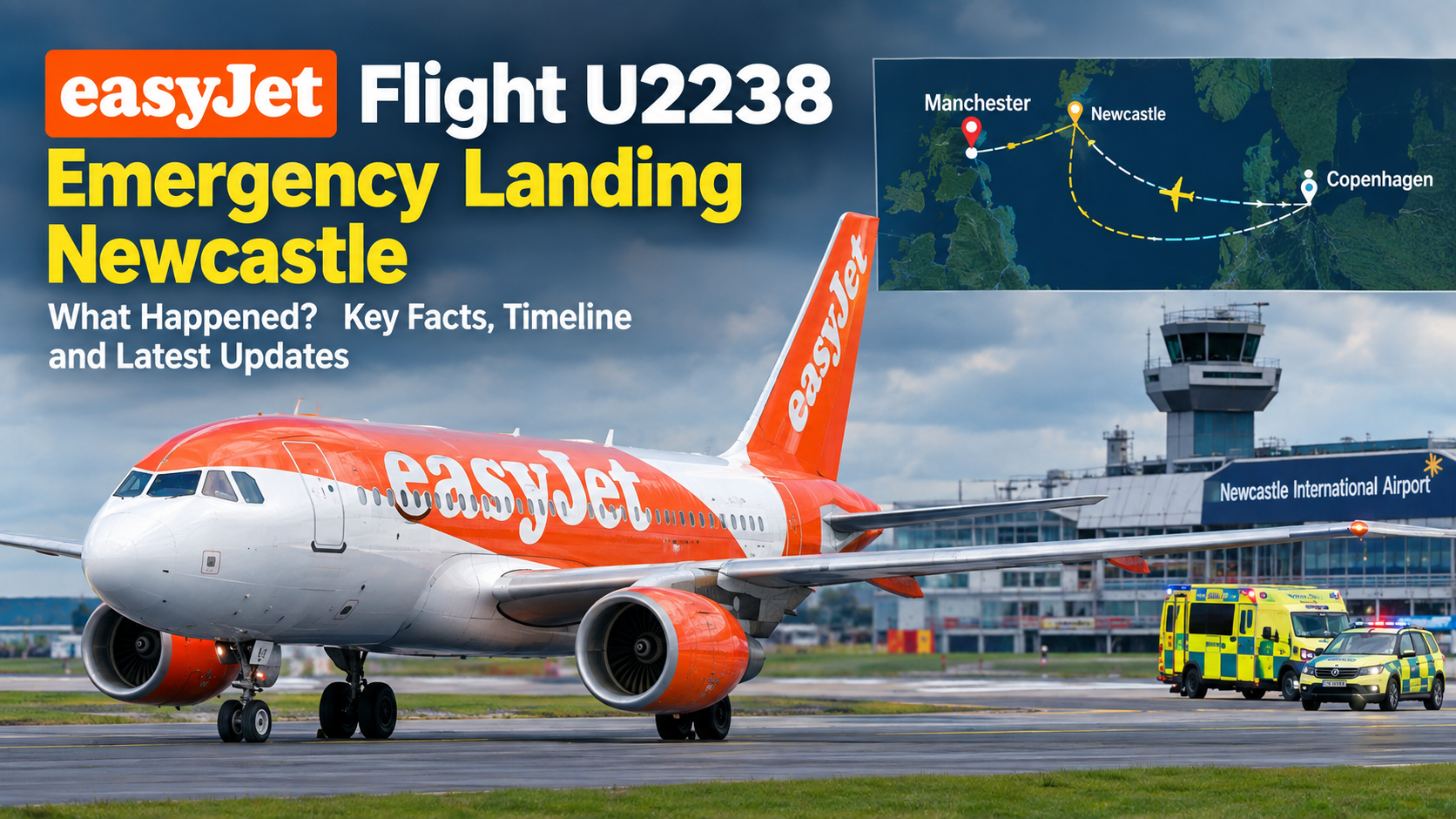
The Airbus A320 was travelling from Copenhagen to Manchester when the crew declared an emergency and diverted to Newcastle. The aircraft landed safely, medical personnel attended to the passenger, and the flight subsequently continued to Manchester.
What Happened to EasyJet Flight U2238?
The incident occurred during an easyJet service from Copenhagen Airport in Denmark to Manchester Airport in England on the evening of 27 October 2025. According to contemporary aviation reporting, a passenger developed a welfare or medical problem while the aircraft was in flight.
The crew responded by declaring an emergency and diverting toward Newcastle International Airport. The aircraft used the general emergency transponder code 7700, which tells air traffic control that an aircraft has an emergency but does not, by itself, identify what caused the emergency.
The aircraft landed safely at Newcastle. Medical responders met the aircraft after arrival, allowing the passenger to receive appropriate assistance. The aircraft was subsequently able to continue its original journey to Manchester.
Was It Really U2238 or U22238?
This is the most important detail for anyone researching the easyJet flight U2238 emergency landing Newcastle story.
The incident flight was easyJet U2 2238, which can appear as U22238 when the airline’s two-character IATA designator and flight number are combined. Aviation tracking sources also identify the service as EZY2238.
By contrast, U2238 represents U2 flight 238, a different easyJet service. Current flight-history records identify U2238 as a Newcastle-to-Bristol service.
| Identifier | Route/service | Connection to the incident |
|---|---|---|
| U2 2238 / U22238 | Copenhagen → Manchester | Flight involved |
| EZY2238 | Copenhagen → Manchester | Operational identifier for the same flight |
| U2238 / U2 238 | Newcastle → Bristol | Separate easyJet service |
The difference is only one digit, but it changes the identity of the flight. For accurate reporting, the October 2025 diversion should therefore be described as U22238/EZY2238, while the exact keyword remains useful because it reflects what many people search for online.
Why Did the Plane Divert to Newcastle?
The reported reason was a passenger welfare or medical emergency, rather than a confirmed aircraft malfunction. Contemporary reporting said the crew diverted after a passenger required urgent medical assistance.
An emergency diversion does not necessarily mean that the aircraft itself is damaged or experiencing an engine problem. Airlines and flight crews can divert when a passenger becomes seriously unwell because reaching an airport with suitable emergency medical facilities may be more appropriate than continuing to the planned destination.
In this case, the available reporting does not establish an engine failure, fire, structural problem, or crash-related emergency as the reason for the Newcastle landing. The emergency declaration should therefore not be interpreted as proof of a major mechanical failure.
What Does Squawk 7700 Mean?
Squawk 7700 is a standard transponder code used to alert air traffic control that an aircraft is experiencing a general emergency.
It does not specify whether the emergency involves a passenger, medical problem, technical issue, weather, or another operational situation. Therefore, seeing 7700 on a flight-tracking website cannot by itself establish that an aircraft was in danger of crashing or had suffered an engine failure.
For the Newcastle incident, the emergency code appeared alongside reporting that connected the diversion to a passenger welfare situation.
What Aircraft Was Involved?
Contemporary aviation reporting identifies the aircraft as an Airbus A320-214, registration G-EZPB. The aircraft was operating the Copenhagen-to-Manchester service when the diversion occurred.
Flight tracking information reported that the aircraft was cruising over the North Sea before the emergency was declared and the route was changed toward Newcastle. The precise flight-track details can vary slightly between tracking systems, so operational data should be treated as tracking information rather than a substitute for an official accident or incident investigation.
When Did the Aircraft Land in Newcastle?
According to contemporary flight reporting, the aircraft landed at Newcastle Airport at approximately 22:52 GMT on 27 October 2025. It then taxied to the stand, where medical personnel attended to the passenger.
The aircraft did not remain at Newcastle as its final destination. After the medical situation had been dealt with, the flight resumed toward Manchester and arrived there shortly after midnight on 28 October 2025.
This sequence is important because it shows that the Newcastle landing was a diversion, not the end of the scheduled flight.
What Happened After the Emergency Landing?
Once the aircraft reached Newcastle, medical responders took over the passenger’s care. The aircraft was subsequently cleared to continue its journey.
The flight eventually departed Newcastle and continued to Manchester, its originally scheduled destination. Contemporary reporting therefore describes the overall outcome as a safe landing, medical response, and continuation of the journey rather than an aircraft accident.
Information about the passenger’s subsequent medical condition is limited in publicly available reporting. It would therefore be inappropriate to speculate about the person’s diagnosis, treatment, or eventual outcome.
Why Is the Incident Called an “Emergency Landing”?
The phrase “emergency landing” is widely used in online searches because the aircraft declared an emergency and landed somewhere other than its planned destination.
From an aviation-reporting perspective, however, “emergency diversion to Newcastle” is a more precise description of what happened. The aircraft was not reported as crashing or making a forced landing because of catastrophic aircraft damage.
The distinction matters because the term “emergency landing” can make readers assume that the aircraft itself suffered a severe mechanical failure. The available evidence instead points to an urgent passenger welfare situation as the reason for the diversion.
How the Flight-Number Confusion Started
The confusion is largely caused by easyJet’s airline identifiers and the repeated number 2.
easyJet’s IATA designator is U2. When flight number 2238 is added, the result is written as U2 2238. Some databases concatenate those elements as U22238.
The airline’s ICAO-style identifier is EZY, producing EZY2238 for the same service. Flight-tracking discussions from the night of the incident also identified the aircraft as U22238/EZY2238.
Meanwhile, U2238 means U2 flight 238, which is a separate Newcastle-to-Bristol service in current flight records.
This explains why someone searching for “easyJet flight U2238 emergency landing Newcastle” may encounter apparently conflicting information. The search phrase is associated with the 2025 incident, but the technically accurate identifier for that incident is U22238/EZY2238.
Was There an Aircraft Crash or Major Mechanical Failure?
No crash was reported. The aircraft landed safely at Newcastle and later continued to Manchester.
There is also no reliable evidence in the sources reviewed that an engine failure, fire, or catastrophic structural problem caused the diversion. The available contemporary reporting instead identifies the emergency as a passenger welfare or medical situation.
That distinction is particularly important when interpreting social-media posts or flight-tracking screenshots. A sudden change in altitude, a 7700 transponder code, or a diversion can look dramatic on a tracking map, but those details alone do not establish the nature or severity of an emergency.
Key Facts at a Glance
| Detail | Verified information |
|---|---|
| Airline | easyJet |
| Incident date | 27 October 2025 |
| Flight involved | U2 2238 / U22238 / EZY2238 |
| Common search term | U2238 |
| Planned route | Copenhagen to Manchester |
| Diversion airport | Newcastle International Airport |
| Aircraft | Airbus A320-214 |
| Registration | G-EZPB |
| Reported reason | Passenger welfare/medical emergency |
| Emergency code | Squawk 7700 |
| Landing | Safe landing at Newcastle |
| Final destination | Manchester |
| Subsequent journey | Continued to Manchester |
The core facts are supported by contemporary aviation reporting and current flight-history data.
What Travelers Can Learn From the Incident
Unexpected diversions are a normal part of commercial aviation’s safety procedures. A flight crew may change the destination when continuing to the planned airport is less appropriate than landing elsewhere, particularly when urgent medical assistance is required.
For passengers, a diversion can mean a longer journey, delays, missed connections, or changes to onward travel. Those consequences can be frustrating, but the decision to divert is made within the aircraft’s operational and safety framework.
This incident also illustrates why flight-tracking information should be interpreted carefully. Tracking services can provide valuable information about an aircraft’s route and emergency status, but they generally cannot explain the full circumstances behind an emergency without supporting information from the airline, airport, air traffic authorities, or credible aviation reporting.
FAQ
Did easyJet flight U2238 make an emergency landing in Newcastle?
The incident commonly associated with that search phrase involved easyJet U2 2238, also written U22238 or EZY2238. It diverted from Copenhagen to Newcastle on 27 October 2025 because a passenger required urgent medical assistance.
Why did the easyJet flight land in Newcastle?
The aircraft diverted because of a passenger welfare or medical emergency. Medical responders attended the aircraft after it landed.
Did the easyJet plane crash?
No. The Airbus A320 landed safely at Newcastle and subsequently continued to Manchester.
Was there an engine failure on the flight?
There is no reliable evidence in the sources reviewed that an engine failure caused the diversion. Contemporary reporting connected the emergency to a passenger welfare issue.
What does U22238 mean compared with U2238?
U22238 refers to easyJet’s U2 flight 2238, the Copenhagen-to-Manchester service involved in the October 2025 diversion. U2238 represents U2 flight 238, a separate Newcastle-to-Bristol service. Current flight-history records support this distinction.
Did the flight eventually reach Manchester?
Yes. After the Newcastle diversion and medical response, the aircraft continued to Manchester and completed the journey.
Also read: The Jolly Rogers Taste of Paradise Ice Cream Truck Sterling AK

1 Comment
Pingback: Ohio Champion Trees Delaware County USD Lewis Center: What the Records Show