

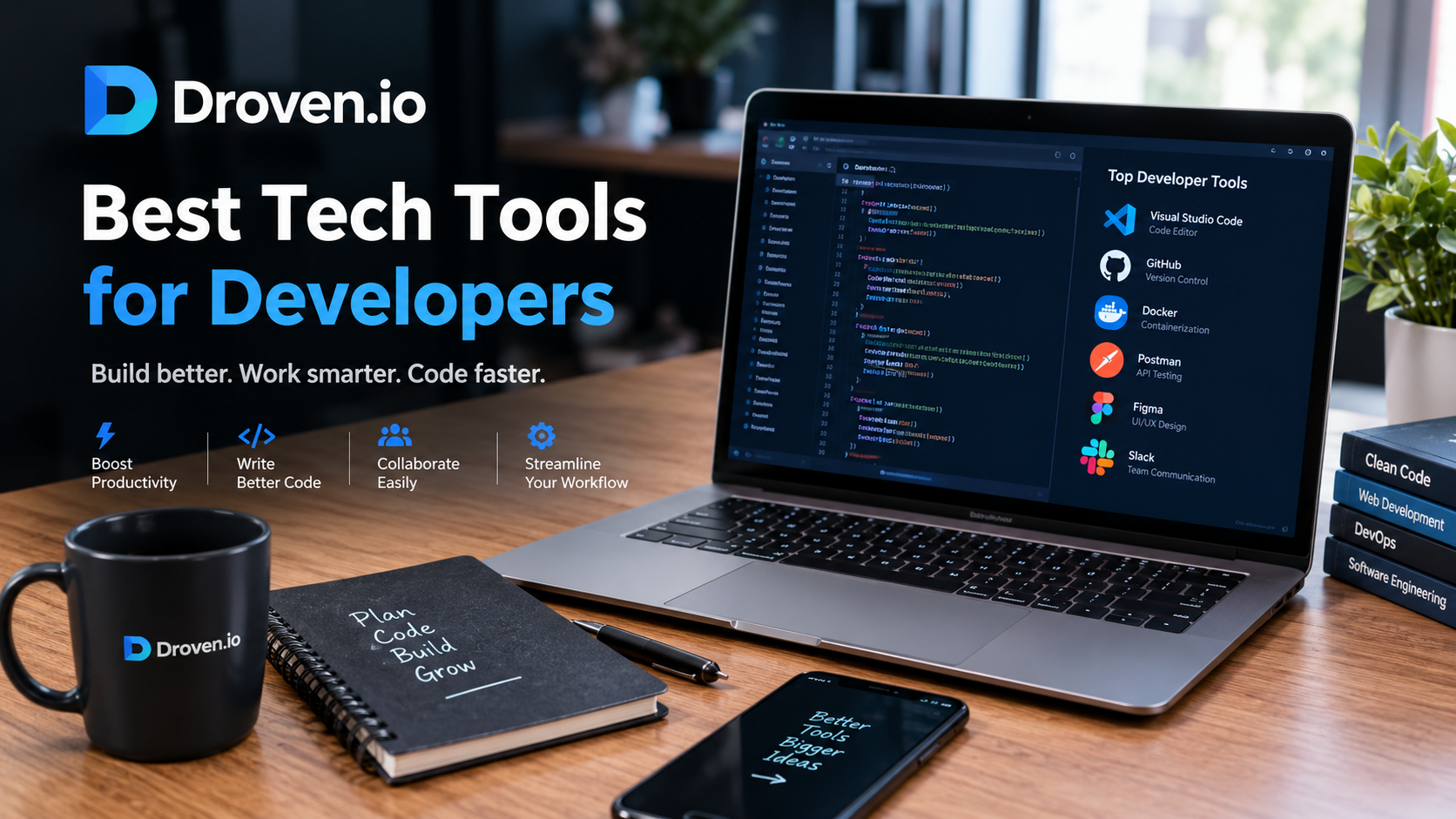
Droven. io best tech tools for developers is best understood as a search for useful software development tools covered or relevant to the technology topics discussed by Droven.io. Droven.io itself is an editorial technology and AI platform, not a coding application or developer software suite. Its official site says it covers artificial intelligence, emerging technologies, startups, development, and future technology.
For developers, the most useful approach is therefore to look at the actual tools that support coding, AI-assisted development, API work, testing, containers, infrastructure, and deployment. This guide focuses on practical tools and explains where each fits rather than presenting an unsupported official “Droven.io ranking.”
What Is Droven.io?
Droven.io describes itself as a technology and AI blog focused on “The Future of Intelligence.” Its published categories include AI news, AI tools, machine learning, generative AI, robotics, startups, development, and future technology. The site also says its audience includes startup founders, developers, and technology enthusiasts.
This distinction is important because several third-party pages describe Droven.io as if it were a software platform or developer-tools ecosystem. The public information on Droven.io itself supports a different interpretation: it is primarily an editorial and information platform that discusses technology rather than a single application developers install and use.
Consequently, the phrase “Droven. io best tech tools for developers” is more useful as a discovery query than as the name of a proprietary software package.
Droven. io Best Tech Tools for Developers at a Glance
There is no universal best developer stack. The right combination depends on the language, application architecture, team size, deployment model, and level of automation required.
| Tool | Main category | Useful for |
|---|---|---|
| Visual Studio Code | Code editor | General software development |
| GitHub Copilot | AI-assisted development | Code generation, explanation and agent workflows |
| Docker | Containers | Consistent development and deployment environments |
| Postman | API development | API testing and collaboration |
| Playwright | Testing | Browser and end-to-end testing |
| GitHub Actions | CI/CD | Automated build, test and deployment workflows |
| Terraform | Infrastructure as code | Managing cloud and infrastructure resources |
These tools cover different parts of the development lifecycle, so they should not be viewed as seven interchangeable products.
Visual Studio Code for Everyday Development
Visual Studio Code, commonly called VS Code, is a flexible code editor that supports extensions, source control, debugging and modern AI-assisted development. Microsoft’s official documentation also demonstrates workflows involving GitHub Copilot, source control, extensions, and debugging within VS Code.
Its biggest advantage is flexibility. A developer can start with a relatively lightweight editor and add language support, debugging tools, linters, formatters, Git integrations, container tooling and other extensions as needed.
VS Code is particularly practical for developers who work across multiple languages or frameworks. However, its flexibility can also become a disadvantage when a project accumulates too many extensions or highly customized settings.
Why Developers Use VS Code
Common uses include:
- Writing and editing application code
- Debugging programs
- Working with Git repositories
- Installing language and framework extensions
- Managing project files and workspaces
- Using AI coding assistants
- Working with remote or containerized development environments
The key is to install extensions based on an actual workflow requirement rather than adding every popular extension available.
GitHub Copilot for AI-Assisted Coding
AI coding assistants have become an important part of modern development workflows. GitHub Copilot can provide code suggestions, chat-based assistance and agent-oriented capabilities across GitHub, supported IDEs and the command line. GitHub’s current documentation also describes Copilot agents that can independently perform research, planning and coding tasks.
For developers, Copilot can be useful for generating boilerplate, explaining unfamiliar code, producing tests, suggesting implementations and helping with repetitive programming tasks.
GitHub’s current Copilot plans also show how quickly this category is changing. The company lists a Free plan, paid individual plans, and business and enterprise offerings, with features such as code completion, cloud agents and code review varying by plan.
What Developers Should Watch With AI Tools
AI-generated code still requires human review. Developers need to check:
- Security vulnerabilities
- Incorrect assumptions
- Dependency choices
- Performance
- Licensing and intellectual-property considerations
- Test coverage
- Compatibility with the existing codebase
GitHub itself notes that Copilot suggestions can occasionally match publicly available code and provides controls and filtering mechanisms related to public-code matches.
The practical lesson is simple: AI can accelerate development, but it does not remove the need for code review.
Docker for Consistent Development Environments
Docker is designed to package and run applications in containers. According to Docker’s official documentation, containers provide isolated environments containing what an application needs to run, which can help reduce differences between development, testing and production environments.
This makes Docker particularly useful when a project depends on several services. A web application might require a frontend, API server, database, cache and additional services. Instead of installing everything directly on each developer’s machine, teams can define containerized environments.
Docker Compose can also define multiple containers and their configuration in a YAML file. Docker says this allows a project to keep the development stack in a version-controlled definition that other developers can start more consistently.
When Docker Makes Sense
Docker is particularly useful when:
- Developers need consistent environments
- Applications have multiple services
- Teams want reproducible local setups
- CI/CD pipelines require standardized environments
- Applications are being prepared for container-based deployment
Docker can add complexity to very small projects, so containerization is not automatically necessary for every application.
Postman for API Development and Testing
Postman is focused on API development, testing and collaboration. Its documentation describes workspaces, collections, environments, collaboration features, API publishing and version-control capabilities.
For a backend developer, Postman can make it easier to send requests, inspect responses, organize API calls and collaborate with other developers or API consumers.
Collections are particularly useful because related requests can be grouped into reusable workflows. Teams can also collaborate around API projects rather than passing individual request configurations between developers.
Who Benefits Most From Postman?
Postman can be useful for:
- Backend developers
- Full-stack developers
- API teams
- QA engineers
- Developers integrating third-party APIs
- Teams documenting and testing API workflows
For developers who primarily build simple frontend applications with few external APIs, a dedicated API platform may not be necessary for every project.
Playwright for Browser and End-to-End Testing
Playwright is a browser automation and testing framework designed for modern web applications. Its official documentation states that it can run tests across Chromium, Firefox and WebKit, along with branded browsers such as Chrome and Microsoft Edge. It also supports device emulation and CI-oriented installation options.
This makes Playwright useful when developers need to test actual user interactions rather than only individual functions.
A test can simulate actions such as opening a page, filling out a form, clicking a button, navigating between pages and verifying that the expected result appears.
Why End-to-End Testing Matters
Unit tests can verify individual pieces of code, but browser testing can catch problems involving the complete user journey.
For example, an application might have a correctly functioning login function but still fail because:
- The login page sends the wrong request.
- The browser receives an unexpected response.
- The session is not stored correctly.
- The user is redirected to the wrong page.
End-to-end testing helps examine the application from the user’s perspective.
GitHub Actions for CI/CD Automation
GitHub Actions provides automation directly inside GitHub repositories. GitHub describes it as a continuous integration and continuous delivery platform that can automate build, test and deployment pipelines.
A common workflow is to automatically run tests whenever a developer pushes code or opens a pull request. If the tests pass, another workflow can build the application or deploy it to a target environment.
GitHub Actions supports hosted runners for Linux, Windows and macOS, as well as self-hosted runners.
Typical GitHub Actions Workflow
A basic development pipeline might look like this:
Code change → Pull request → Automated tests → Build → Review → Deployment
This reduces the amount of manual work required to perform repetitive checks.
The important limitation is that automation is only as reliable as the workflow configuration. Poorly designed pipelines can create slow builds, confusing failures or unsafe deployment processes.
Terraform for Infrastructure as Code
Terraform is an infrastructure-as-code tool from HashiCorp. Its purpose is to let developers and infrastructure teams define infrastructure using configuration files instead of manually configuring every resource through graphical interfaces.
Terraform can manage resources across cloud and on-premises environments, including computing, storage, networking, DNS and other services. Its configuration can be versioned and reviewed in much the same way as application code.
A typical Terraform workflow involves defining resources, initializing the required providers, generating a plan and then applying the desired changes. Terraform maintains state information to track infrastructure and determine required changes.
Why Infrastructure as Code Matters
Manual infrastructure configuration becomes increasingly difficult as applications grow.
Terraform can help teams:
- Reproduce environments
- Review infrastructure changes
- Version configuration
- Reduce repetitive manual setup
- Standardize infrastructure
- Manage resources across multiple providers
Terraform itself does not eliminate infrastructure risk. Incorrect configuration can still create outages, security problems or unexpected costs, so infrastructure changes should be reviewed carefully.
How These Tools Fit Together
The most useful way to understand the Droven. io best tech tools for developers topic is as a development workflow rather than a ranking.
A small web-development project might use VS Code for coding, GitHub for source control, Playwright for browser tests and GitHub Actions for automation.
A larger application could add Docker for consistent environments and Postman for API workflows.
A team managing substantial cloud infrastructure might additionally use Terraform to define and maintain its infrastructure.
The resulting workflow could look like this:
VS Code → GitHub → Copilot → Docker → Postman → Playwright → GitHub Actions → Terraform
Not every project needs every component. A developer should add a tool when it solves a real problem.
How to Choose the Right Developer Tools
The best tool depends on the problem you are trying to solve.
For Coding
Start with an editor or IDE that supports your language and workflow. VS Code is a flexible option, while specialized IDEs may provide deeper functionality for particular languages or ecosystems.
For AI Assistance
Consider an AI coding assistant when repetitive coding, code explanation, test generation or repository-level tasks are consuming significant time. Always review generated output before merging it.
For APIs
Use an API development and testing platform when your project has multiple endpoints, external integrations or a team that needs to collaborate around API definitions.
For Testing
Choose testing tools according to what you need to validate. Unit testing, integration testing and browser-based end-to-end testing solve different problems.
For Deployment
CI/CD becomes increasingly valuable as projects move from manual deployment to repeatable automated releases.
For Infrastructure
Infrastructure-as-code tools become more useful when environments are complex, reproducibility matters or multiple people need to manage infrastructure safely.
Common Mistakes When Building a Developer Tool Stack
More tools do not automatically mean greater productivity.
One common mistake is installing multiple applications that solve almost the same problem. This can increase maintenance and create conflicting workflows.
Another mistake is adopting a sophisticated tool before the project actually needs it. Kubernetes, infrastructure-as-code systems and elaborate CI/CD pipelines can be valuable, but a small personal application may not require that level of operational complexity.
Security is another important consideration. Developer tools often have access to source code, credentials, repositories, infrastructure or production systems. Permissions should therefore be limited to what each tool actually needs.
Finally, developers should evaluate documentation and maintenance. A tool that is difficult to update or poorly documented can create more work than it saves.
Is Droven.io Itself a Developer Tool?
No. Based on Droven.io’s current public positioning, it is an editorial technology and AI website rather than a code editor, API platform, cloud provider or development environment. The official homepage describes it as a source for AI, emerging technology, startups, development and related topics.
That means developers should treat Droven.io as an information and discovery resource, while evaluating the actual software products through their respective official documentation.
This distinction is especially important when reading third-party articles that describe Droven.io as if it owns, operates or officially ranks the tools mentioned in those articles.
What Makes a Developer Tool Worth Using?
A useful developer tool should solve a specific problem without introducing unnecessary complexity.
Five practical questions can help:
- Does it solve a real workflow problem?
- Does it integrate with the tools already in use?
- Is the documentation good enough for the team?
- Can the team maintain it over time?
- Does its security and permission model fit the project?
Cost also matters, but the cheapest tool is not always the least expensive choice. Developer time, migration effort, training and maintenance can be more significant than the subscription price.
Frequently Asked Questions
What is Droven. io best tech tools for developers?
The phrase generally refers to useful developer tools associated with the technology topics covered by Droven.io. It is not the name of a single official Droven software package.
Is Droven.io a software development platform?
No. Droven.io currently presents itself as an editorial technology and AI platform covering areas such as AI, development, startups, robotics and emerging technology.
Which tools are useful for modern developers?
Useful options include Visual Studio Code for development, GitHub Copilot for AI-assisted coding, Docker for containers, Postman for APIs, Playwright for browser testing, GitHub Actions for CI/CD and Terraform for infrastructure as code.
Is GitHub Copilot suitable for professional development?
It can support professional development workflows, including code suggestions, chat, code review and agent-oriented tasks, but generated code still needs appropriate human review and testing. GitHub currently documents Copilot capabilities across editors, GitHub and command-line workflows.
Why do developers use Docker?
Docker packages applications and their dependencies into containers, helping developers create more consistent and portable environments across machines and deployment targets.
Do developers need all of these tools?
No. Developers should select tools according to their project’s actual requirements. A simple application may need only an editor, version control and basic testing, while a larger production system may benefit from containers, automated CI/CD, API tooling and infrastructure as code.
Also read: DreamMeaniing.com USA

3 Comments
Pingback: Peacock Login: How to Sign In and Fix Account Problems
Pingback: 12 Unique Business Ideas for 2026
Pingback: BusinessU: High School Business Education Platform Guide