

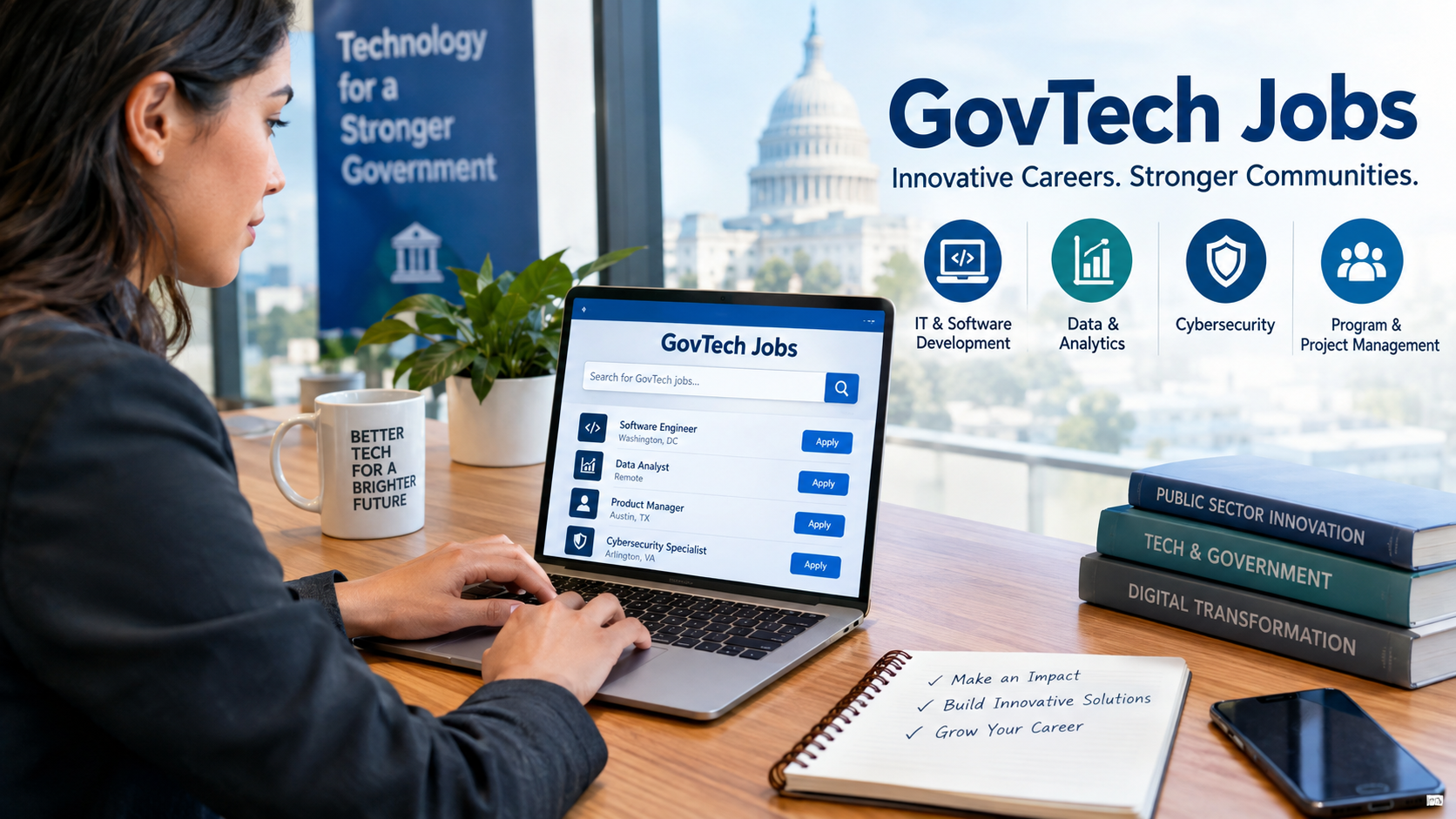
GovTech jobs are careers focused on using technology, data, digital services, cybersecurity, and modern software to improve government operations and public services. They can be found directly inside government agencies, government digital-service organizations, and private companies that build technology for the public sector.
The field is broader than traditional government IT. Depending on the organization, GovTech professionals may work on digital identity, cloud infrastructure, artificial intelligence, cybersecurity, software platforms, data governance, service design, or citizen-facing applications.
What Are GovTech Jobs?
GovTech is commonly used to describe technology-driven modernization of government. The OECD defines GovTech around collaboration between the public sector and start-ups, innovators, government innovators, and academia to develop digital-government solutions. The World Bank uses a broader whole-of-government approach focused on citizen-centric services, accessibility, digital transformation, and stronger government systems.
As a result, GovTech jobs can exist in several types of organizations:
- Government ministries and departments
- Digital government agencies
- Public-sector technology teams
- Government-owned technology organizations
- GovTech startups and software companies
- Consulting and systems-integration firms
- Research institutions and universities
- Organizations working on digital public infrastructure
The exact meaning of a GovTech role varies by country and employer. A software engineer working on a government digital platform and a policy specialist developing AI governance can both work within the GovTech ecosystem.
Why GovTech Is Creating New Career Opportunities
Governments are increasingly expected to provide digital services that are accessible, secure, reliable, and easier to use. This requires capabilities that go beyond conventional administrative roles.
The OECD notes that governments face difficulties attracting and retaining specialized digital talent because they compete with the private sector for technology professionals. It also identifies AI, data access and sharing, open-source technology, agile methods, and demand for better digital services as important factors behind the development of GovTech.
The World Bank similarly describes GovTech as a modernization approach covering core government systems, citizen engagement, service delivery, regulation, skills development, and collaboration with the private sector.
This creates opportunities for people with both technical and non-technical backgrounds.
Common Types of GovTech Jobs
GovTech does not represent one specific profession. It is an ecosystem containing many different roles.
| Job area | Typical responsibilities |
|---|---|
| Software engineering | Build and maintain government applications and platforms |
| Cybersecurity | Protect government systems, networks, and data |
| Cloud engineering | Design and manage scalable cloud infrastructure |
| Data engineering | Build systems for collecting, processing, and sharing data |
| Artificial intelligence | Develop or govern AI and machine-learning applications |
| UX/UI design | Make digital public services easier to use |
| Product management | Define and manage digital products and services |
| Digital transformation | Help organizations modernize processes and technology |
| Data governance | Establish rules for responsible data management |
| Policy and regulation | Develop technology-related policies and frameworks |
| Project/program management | Coordinate large technology initiatives |
| Technical architecture | Design how complex digital systems work together |
| Procurement and partnerships | Manage technology suppliers and public-private collaboration |
Current government hiring illustrates how wide the field has become. For example, Singapore’s GovTech agency says it recruits across software engineering, cybersecurity, data engineering, design, government ICT infrastructure, and smart-city technology.
Software Engineering GovTech Jobs
Software engineers are needed to build the applications and platforms that governments use internally and that citizens access directly.
Typical work can include:
- Backend and frontend development
- APIs and system integrations
- Mobile applications
- Government portals
- Authentication systems
- Workflow automation
- Testing and quality assurance
- DevOps and continuous delivery
- Legacy-system modernization
A strong software engineering foundation is generally more important than knowing a particular government platform before applying. Programming experience, software architecture, testing, databases, APIs, version control, and secure development practices can all be relevant.
Cybersecurity GovTech Jobs
Government systems often handle sensitive information and provide services that people depend on, making cybersecurity an important GovTech specialization.
Cybersecurity positions can involve security architecture, threat detection, incident response, identity management, risk assessment, compliance, vulnerability management, and security operations.
Candidates may benefit from knowledge of networking, operating systems, cloud security, identity and access management, encryption, security frameworks, and incident-response procedures.
Certifications can help demonstrate knowledge, although their value depends on the specific role and employer.
AI and Data GovTech Jobs
Artificial intelligence and data are becoming increasingly relevant to digital government. GovTech organizations may use data engineering, machine learning, analytics, natural-language processing, and AI governance to improve services and administrative processes.
However, working with AI in government is not limited to building models. There is also demand for professionals who understand data quality, privacy, responsible AI, risk management, policy, and governance.
For example, Pakistan’s Digital Authority currently lists positions and functions involving AI, data governance, data exchange, AI assurance, digital trust, and software engineering. Its published vacancies include an AI Associate role requiring knowledge of Python and AI/ML technologies, with familiarity with LLMs, RAG, APIs, cloud platforms, and MLOps identified as useful skills.
Cloud and Infrastructure GovTech Jobs
Digital government increasingly depends on reliable infrastructure. Cloud engineers, infrastructure architects, network specialists, DevOps professionals, and platform engineers can therefore find opportunities in the public sector.
Responsibilities may include:
- Cloud architecture
- Infrastructure automation
- Network design
- Platform reliability
- Disaster recovery
- Monitoring and observability
- Identity and access management
- Infrastructure security
- Hybrid-cloud environments
Pakistan’s Digital Authority, for example, has published a Director Cloud position involving cloud infrastructure and services across government platforms and digital public infrastructure. The listed requirements include experience in cloud architecture, infrastructure management, security, governance, and large-scale environments.
Non-Technical GovTech Jobs
You do not necessarily need to be a programmer to work in GovTech.
Government technology projects require people who understand users, policy, organizations, communication, procurement, and project delivery.
Relevant roles include:
- Product manager
- Business analyst
- Policy analyst
- UX researcher
- Service designer
- Technical writer
- Program manager
- Legal and regulatory specialist
- Procurement specialist
- Partnerships manager
- Data-policy specialist
- Change-management professional
The UK’s Government Digital Service, for example, describes its workforce as including product managers, software engineers, designers, researchers, technical architects, and other specialists.
What Skills Do GovTech Employers Look For?
The requirements depend heavily on the position, but several skills appear repeatedly across GovTech work.
Technical Skills
For technical roles, useful areas include:
- Programming languages such as Python, JavaScript, Java, or similar technologies
- Databases and SQL
- APIs and system integration
- Cloud platforms
- Cybersecurity
- Data engineering
- AI and machine learning
- DevOps
- Software testing
- System architecture
- Git and collaborative development
You do not need every skill. The better approach is to match your technical skills to a specific job description.
Problem-Solving
Government technology projects often involve complex systems, regulations, legacy infrastructure, multiple stakeholders, and large user populations.
Employers therefore need people who can break complicated problems into manageable parts, evaluate trade-offs, and communicate practical solutions.
Communication and Collaboration
GovTech projects rarely involve technology teams working in isolation. Engineers may work with policy teams, lawyers, designers, administrators, vendors, and government officials.
Clear written and verbal communication can therefore be as important as technical knowledge for many roles.
Security and Privacy Awareness
People working with government data need to understand that technical decisions can have significant privacy, security, and public-service implications.
Even candidates who are not cybersecurity specialists can benefit from understanding basic security principles, data protection, access control, and responsible technology use.
Where to Find GovTech Jobs
There is no single global GovTech job board. Searching directly through government career portals and digital-service organizations is often the most reliable approach.
United States
In the United States, USAJOBS is the federal government’s official employment website. Its technology categories include information technology management, an AI portal, and cybersecurity opportunities.
Useful search terms include:
- Information Technology
- Software Engineer
- IT Specialist
- Cybersecurity
- Data Scientist
- AI
- Cloud
- Digital Services
- Product Manager
United Kingdom
The UK’s Government Digital Service is part of the Department for Science, Innovation and Technology and serves as the digital centre of government. GDS says its workforce includes more than 1,000 specialists, including engineers, designers, product managers, researchers, and technical architects.
Government Digital Service recruitment
Singapore
Singapore’s Government Technology Agency, known as GovTech Singapore, recruits both technical and non-technical professionals. Its current careers information highlights opportunities for software engineers, cybersecurity specialists, data engineers, designers, infrastructure professionals, and smart-city technology specialists.
Pakistan
Pakistan’s Digital Authority maintains an official careers page with current and previously published opportunities related to digital transformation. Its September 2026 listings include positions such as Executive Director for Digital Economy, Business Analyst, AI Associate, and Director for Information & Security.
Pakistan Digital Authority careers
Because government vacancies can close or change quickly, applicants should verify the deadline and status on the official employer website before applying.
Germany and Other Markets
GovTech opportunities also exist outside traditional government agencies. For example, the GovTech Campus Germany job portal currently lists positions involving GovTech project management, solution architecture, engineering, security, partnerships, and digital transformation.
This illustrates an important point: GovTech jobs can be located both inside government and in private or nonprofit organizations that work closely with government.
How to Prepare for GovTech Jobs
Start by selecting a specific career direction rather than trying to become an expert in every part of technology.
A software engineer could focus on backend development, APIs, cloud, security, or platform engineering. A data professional might concentrate on data engineering, analytics, AI, or data governance. Someone with a policy background could specialize in digital regulation, technology policy, responsible AI, or digital transformation.
Build a portfolio that demonstrates practical ability. For technical applicants, this might include a public-service application, data project, API, accessibility-focused website, cybersecurity project, or cloud deployment.
For non-technical applicants, useful portfolio material could include a service-design case study, policy analysis, process-improvement project, product requirements document, or research project.
How to Make a GovTech Resume Stronger
A GovTech resume should show both what you did and what changed because of your work.
Instead of writing:
Worked on a software project.
A stronger description explains the technology, responsibility, and measurable result, such as:
Developed a Python-based API that automated data processing and reduced manual reporting work for the project team.
The exact result should always be truthful and supported by your actual experience.
Government technology employers may also place significant emphasis on security, compliance, documentation, collaboration, and stakeholder management. Singapore’s GovTech hiring guidance specifically recommends clearly formatted CVs, quantified accomplishments, relevant certifications, preparation for competency interviews, and a professional online presence.
Do GovTech Jobs Require a Government Background?
No. Many GovTech positions are primarily technology, design, data, product, or engineering roles, so previous government employment is not automatically required.
What matters depends on the position. Some jobs may require knowledge of public-sector processes, security requirements, procurement, regulation, or government policy, while technical positions may place greater emphasis on engineering skills and relevant experience.
Always check the eligibility and experience requirements for the specific vacancy.
Are GovTech Jobs Remote?
Remote work varies considerably by employer, country, security requirements, and role.
Some organizations advertise remote or hybrid positions, while roles involving sensitive government infrastructure may require employees to work from designated locations or meet additional security requirements.
For example, current GovTech Campus Germany listings include positions described as remote in some cases, while Singapore GovTech describes its roles through its own recruitment process rather than presenting all positions as universally remote.
The job advertisement should be treated as the authoritative source for location and work-arrangement requirements.
Advantages and Challenges of a GovTech Career
GovTech can offer the opportunity to work on technology used by large populations and to solve problems involving public services. It can also expose professionals to complex areas such as digital identity, public infrastructure, cybersecurity, accessibility, data governance, and large-scale platforms.
The challenges are different from those found in many private-sector technology companies. Government projects can involve procurement requirements, legacy systems, regulatory constraints, multiple stakeholders, lengthy decision processes, and high expectations for security and reliability.
The OECD notes that GovTech is still evolving and that governments continue to face challenges in building the capabilities and conditions needed for successful digital innovation.
GovTech vs. Traditional Government IT
Traditional government IT can involve maintaining existing systems, networks, databases, hardware, and internal applications.
GovTech can include those responsibilities, but the concept often extends further into digital transformation, citizen-facing services, innovative technology, startups, data-driven government, and collaboration between public and private organizations.
The distinction is therefore not absolute. Government IT and GovTech overlap significantly, and different organizations use the term in different ways. The OECD explicitly notes that there is not yet one universally accepted definition of GovTech.
What Is the Future of GovTech Jobs?
The direction of GovTech employment is closely connected to the broader modernization of government services. Areas such as artificial intelligence, cloud infrastructure, cybersecurity, digital identity, data governance, interoperability, accessibility, and digital public infrastructure are increasingly important to government technology programs.
This does not mean every GovTech worker will become an AI specialist. Instead, the field is becoming more multidisciplinary, requiring combinations of technology, public policy, design, security, data, and organizational skills.
For job seekers, the practical lesson is to develop a clear specialization while learning how technology operates within public-sector constraints.
Frequently Asked Questions About GovTech Jobs
What are GovTech jobs?
GovTech jobs involve developing, managing, securing, designing, or governing technology used to modernize government and deliver public services. They include software engineering, cybersecurity, data, AI, cloud, product management, UX, policy, and digital transformation roles.
Do I need a computer science degree for GovTech jobs?
Not always. A computer science or related degree can be useful for many engineering and technical positions, but GovTech also employs designers, product managers, policy specialists, researchers, business analysts, project managers, and other professionals.
Where can I apply for GovTech jobs?
Start with official government career websites and digital-government organizations. In the United States, USAJOBS is the federal employment portal; the UK Government Digital Service publishes recruitment information; Singapore GovTech has its own careers system; and Pakistan’s Digital Authority maintains an official careers page.
What skills are useful for GovTech careers?
The most relevant skills depend on the role. Common areas include software development, cloud computing, cybersecurity, data engineering, AI, UX design, product management, communication, problem-solving, privacy, governance, and project delivery.
Can private companies offer GovTech jobs?
Yes. GovTech includes an ecosystem involving governments, startups, established technology companies, consultants, academia, and other organizations. The OECD specifically describes GovTech as collaboration between public-sector organizations and external innovators and institutions.
Are GovTech jobs only for experienced professionals?
No. Some organizations offer opportunities for students, graduates, interns, and early-career professionals alongside experienced and senior positions. Singapore GovTech, for example, explicitly provides career pathways for students, graduates, and working professionals.
Also read: Helonium
