

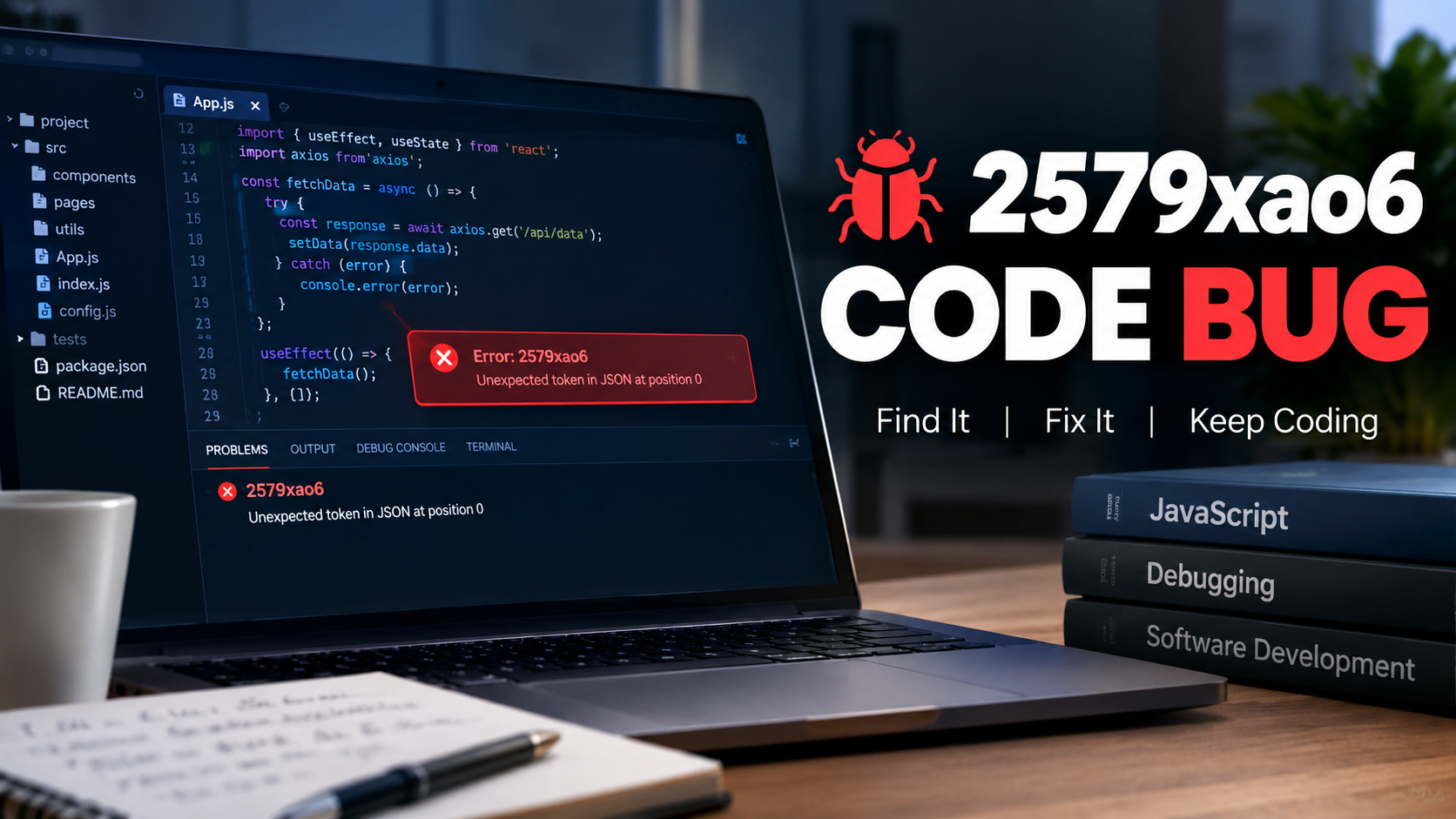
The 2579xao6 code bug does not appear to be a standardized error code, programming language, or official Python exception. Current searches do not identify authoritative documentation for 2579xao6, so the safest approach is to treat it as an unidentified, application-specific, or possibly malformed identifier until its source is established.
If you encountered 2579xao6 in an application, script, website, or log, the surrounding error message is more important than the string itself. The application name, traceback, software version, recent changes, and log entries can reveal what actually failed.
What Is the 2579xao6 Code Bug?
There is currently no verified universal technical definition for 2579xao6. Searches across major technical resources do not identify it as a documented Python exception, standard programming-language error, or recognized cross-platform error code.
The format looks like an alphanumeric identifier rather than a conventional error name. Software systems can generate identifiers for many purposes, including internal errors, requests, transactions, builds, tests, support cases, or log correlation.
This means that seeing something such as:
Error: 2579xao6is not enough to determine the underlying problem. The actual cause could be represented elsewhere in the message or stored in the application’s logs.
Is 2579xao6 an Official Python Error?
No authoritative Python documentation currently identifies 2579xao6 as a built-in Python exception or standard Python error.
Python’s official documentation describes errors using recognized exception types such as TypeError, NameError, ValueError, and ZeroDivisionError. Python tracebacks also provide information about the file, line, exception type, and error message, which gives developers the context needed to diagnose a failure.
Therefore, if 2579xao6 appears alongside Python code, it should not automatically be interpreted as a Python error. It could instead be a custom identifier produced by the application or another component of the software stack.
Why Can the 2579xao6 Code Be Difficult to Diagnose?
Unusual identifiers are difficult to troubleshoot because the characters themselves may contain little information about the underlying failure.
For example, an application could display an internal reference after a failed database request:
Request failed.
Reference: 2579xao6
The reference might help developers locate the corresponding event in server logs, while the actual failure could involve authentication, a database connection, invalid input, or another component.
Modern logging systems can use interaction or correlation identifiers to connect related events from a single operation. OWASP’s logging guidance describes interaction identifiers as a way to link relevant events belonging to the same user interaction or request.
Consequently, the identifier should be investigated together with the surrounding technical evidence rather than in isolation.
What Could Cause an Error Associated With 2579xao6?
Because 2579xao6 has no confirmed universal definition, it would be inaccurate to claim that one particular bug always causes it. However, if an application uses the string as an internal reference, ordinary software problems could be responsible.
Dependency or Version Conflicts
A program may rely on multiple libraries or modules. Updating one component can introduce compatibility problems with another.
Check recent package updates and compare the current environment with the last known working version. For Python projects, dependency files and installed package versions can be particularly useful during troubleshooting.
Configuration Problems
Incorrect configuration can prevent an application from starting or completing a particular operation.
Common examples include:
- Incorrect environment variables
- Invalid API credentials
- Wrong database settings
- Incorrect file paths
- Invalid JSON, YAML, or XML configuration
- Missing required configuration values
If the problem appeared immediately after a configuration change, comparing the new configuration with the previous working version can help isolate the cause.
Missing Files or Modules
An application may fail because a required file, library, module, or resource cannot be found.
In Python, errors such as ModuleNotFoundError, ImportError, and FileNotFoundError provide substantially more diagnostic information than an unexplained identifier.
Python’s documentation explains that exceptions include an exception type and details about what caused the failure, while the traceback shows the execution context.
Invalid Input
Applications can fail when they receive data in an unexpected format.
For example, code expecting an integer might receive text, or an API might receive a missing or incorrectly formatted parameter. The visible 2579xao6 identifier, if present, may simply be associated with the failure rather than being its cause.
Unhandled Exceptions
An unexpected exception can terminate an operation if the application does not handle it appropriately.
Python supports try and except blocks for handling selected exceptions. Its documentation also recommends being specific about exception types rather than treating every possible exception as the same problem.
How to Troubleshoot the 2579xao6 Code Bug
There is no universal fix for 2579xao6 because its underlying meaning has not been established. Instead, use a structured debugging process.
1. Save the Complete Error Message
Do not record only:
2579xao6Save the entire error message, including any text before and after the identifier.
The surrounding information may reveal the actual exception, failed operation, service, or component.
2. Identify the Application
Determine exactly which program or service produced the identifier.
Record:
- Application name
- Application version
- Operating system
- Programming language, if relevant
- Plugin or extension involved
- Date and time of the failure
- Action that triggered the error
This information can distinguish an application-specific identifier from a genuine platform error.
3. Look for a Traceback
If the problem occurs in Python, inspect the complete traceback.
A Python traceback normally identifies where the exception occurred and ends with the exception type and message. The official traceback module also provides functionality for displaying and processing stack traces.
For example:
Traceback (most recent call last):
    ...
TypeError: ...
In a case like this, the TypeError and its message are the important diagnostic information. 2579xao6, if it appears elsewhere, may only be a reference associated with the event.
4. Check Recent Changes
Think about what changed immediately before the problem appeared.
Potential changes include:
- Installing a package
- Updating an application
- Changing configuration
- Modifying source code
- Changing API credentials
- Moving files
- Updating a database
- Installing a plugin
- Changing the operating environment
If the problem started directly after one of these changes, temporarily reverting the change in a safe development environment can help establish whether there is a connection.
5. Inspect Application Logs
Logs can provide information that is not shown in the user-facing error message.
Search for the identifier together with:
- Timestamp
- Exception name
- Request ID
- User action
- Service name
- Database error
- HTTP response
- Stack trace
If 2579xao6 is a correlation or interaction identifier, searching for it may reveal multiple events belonging to the same failed operation.
6. Reproduce the Problem
A reproducible failure is generally easier to diagnose than an intermittent one.
Record the exact steps that cause the problem and determine whether it occurs:
- Every time
- Only with particular input
- Only on one computer
- Only in production
- Only after an application restart
- Only with a specific account or configuration
Reproduction helps narrow the possible causes.
Should You Reinstall Python?
Not automatically.
If 2579xao6 appears while using a Python application, reinstalling Python should not be the first troubleshooting step. First identify the actual exception and determine whether Python itself, a package, the application code, or an external service is responsible.
Python’s documented exception system provides specific error types and tracebacks that can help identify the underlying failure.
Reinstalling an entire development environment without understanding the problem can also remove useful diagnostic information and make it harder to reproduce the original environment.
How Developers Can Handle Unknown Errors Better
Applications should provide useful diagnostic information rather than displaying an unexplained identifier alone.
A better error-reporting approach can include:
Operation failed
Error ID: 2579xao6
Component: Payment API
Exception: ConnectionError
Timestamp: 2026-09-28 12:30:00 UTC
The user-facing message does not necessarily need to expose sensitive technical details, but developers should retain enough information in secure logs to investigate the event.
Python also supports exception chaining, allowing developers to preserve relationships between an original exception and a higher-level exception. This can make debugging more informative when an application translates a low-level failure into a more meaningful application error.
What Not to Do When You See 2579xao6
Avoid assuming that the identifier itself explains the failure.
In particular, do not:
- Install unknown software solely because a webpage associates it with
2579xao6 - Delete system files without identifying the application involved
- Reinstall the operating system as a first step
- Change multiple settings simultaneously
- Hide the original traceback
- Ignore the complete error message
- Assume every website describing the term is authoritative
Search results can contain repeated descriptions that are not backed by official documentation. For an unfamiliar technical identifier, the original application’s documentation and logs are generally more useful than unsupported explanations of what the string supposedly means.
Is There an Official Fix for 2579xao6?
No universal official fix could be verified for 2579xao6.
The main reason is that there is no clearly established standard definition for the identifier. Different software systems can create their own internal codes, so a solution that applies to one application could be irrelevant to another.
The appropriate fix should therefore be based on the actual exception, log entry, application, and conditions that produced the identifier.
Frequently Asked Questions
What does 2579xao6 code bug mean?
2579xao6 does not currently have a verified universal technical definition. It may be an application-specific identifier, internal reference, generated code, placeholder, or another context-dependent value.
Is 2579xao6 an official Python error?
There is no authoritative Python documentation identifying 2579xao6 as a built-in Python exception. Python uses documented exception types and tracebacks to describe runtime and syntax problems.
How can I fix a 2579xao6 code bug?
Start by saving the complete error message, identifying the application that generated it, checking logs and tracebacks, reviewing recent changes, and identifying the actual exception. There is no single confirmed fix for the identifier itself.
Is 2579xao6 a programming language?
There is no verified evidence establishing 2579xao6 as a recognized mainstream programming language. Current technical searches do not identify authoritative documentation defining it as one.
Why does 2579xao6 appear in Python-related searches?
Some web pages associate the term with Python and software development, but that association does not establish 2579xao6 as an official Python feature or package. The actual context where the identifier appeared should be checked.
What information should I collect when this error appears?
Record the complete error message, application and version, operating system, timestamp, recent changes, traceback, relevant log entries, and the exact action that triggered the failure. These details are much more useful for diagnosis than the identifier alone.
Also read: AdsWynk Com

1 Comment
Pingback: BetterThisFacts Tips by BetterThisWorld: A Practical Guide for 2026