

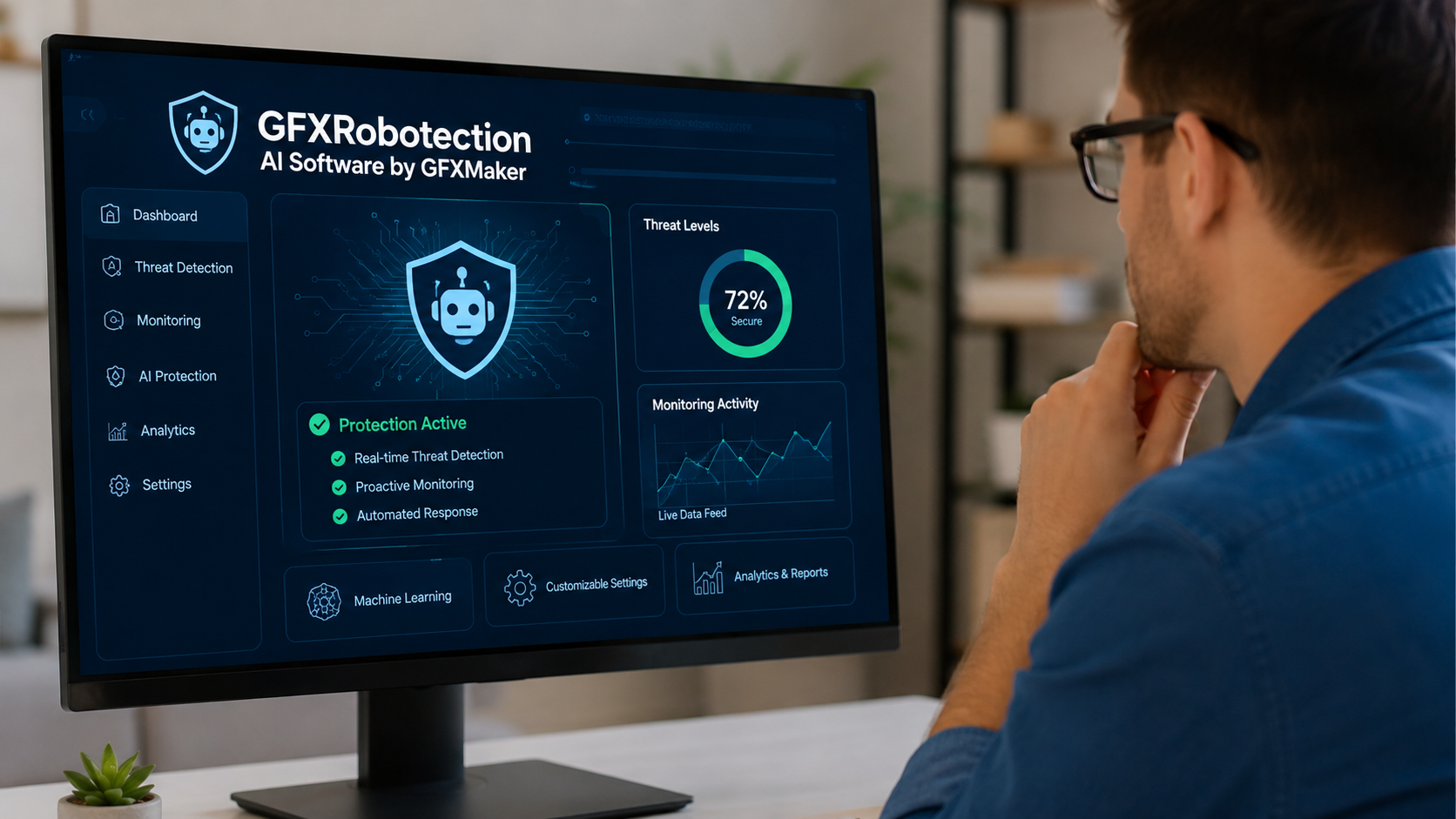
GFXRobotection AI Software by GFXMaker is presented online as a technology for protecting digital artwork and creative assets, but the most important finding is that the public evidence does not currently establish it as a fully documented, independently tested software product.
The official GFXMaker website has an article specifically titled around GFXRobotection and describes features such as real-time threat detection, proactive monitoring, automated responses, machine learning, customizable settings, analytics, and tiered plans. However, those descriptions are presented within an editorial website rather than alongside a clearly documented application, public product dashboard, technical documentation, download channel, or transparent pricing page.
A separate domain, gfxrobotection.com, is also active, but its homepage describes itself primarily as a technology and robotics content hub. It publishes articles on software, artificial intelligence, robotics, gadgets, and digital art, with GFXRobotection-related topics appearing among those posts. That makes it difficult to establish from the public web presence that there is a functioning commercial application behind the name.
For creators considering uploading valuable artwork or paying for protection services, that distinction matters. The concept of AI-assisted image monitoring is real, but the existence of similar technologies elsewhere does not independently verify that GFXRobotection implements them as advertised.
What Is GFXRobotection AI Software by GFXMaker?
The name is currently used to describe a supposed digital-asset protection solution associated with GFXMaker. The GFXMaker article portrays it as a security-oriented system intended to protect creative projects against online threats and unauthorized use. It claims that machine-learning techniques can provide real-time threat detection, proactive monitoring, automated responses, adaptive learning, analytics, and customizable controls.
Other online articles go considerably further, describing GFXRobotection as a combined AI graphic-design and intellectual-property protection system capable of fingerprinting artwork, monitoring websites and social platforms, identifying unauthorized copies, and helping with takedown processes. Those additional descriptions, however, are not supported by publicly accessible technical documentation from GFXMaker that I could verify.
That leaves an important distinction:
The concept is plausible and fits an established area of technology. The specific implementation claimed for GFXRobotection remains insufficiently documented.
This is why it would be misleading to describe the service as a proven cybersecurity or copyright-enforcement platform based only on promotional articles.
What Does the GFXMaker Website Actually Show?
GFXMaker presents itself as a broad creative and technology content website covering graphic design, technology, software, marketing, and 3D printing. Its About page describes the site as a destination for information, trends, insights, and educational material rather than clearly presenting the company as a dedicated software vendor.
Its Software section is similarly article-oriented. The category contains tutorials, software discussions, Photoshop material, technology articles, and other editorial content rather than a conventional product catalog showing downloadable GFXMaker applications.
The GFXRobotection article itself is therefore best understood as a description of a claimed product, rather than sufficient evidence that a publicly usable application is available.
That does not prove that no private, early-stage, or unreleased product exists. It simply means that the public evidence currently falls short of what buyers normally need before trusting a security-sensitive application.
HTML Visual — Verification Snapshot
Reported Features: What the Product Is Supposed to Do
The official GFXMaker article describes GFXRobotection as more than a conventional graphic-design tool. Its stated purpose is to protect digital assets through automated monitoring and security mechanisms.
Real-time threat detection: The article says the system analyzes activity continuously and can identify potential threats.
Proactive monitoring: Rather than waiting for a user to discover a problem manually, the claimed system is described as monitoring digital environments continuously.
Automated responses: GFXMaker says the software can respond to identified incidents automatically.
Adaptive learning: The product is described as using machine-learning capabilities that adapt to changing threats.
Analytics and dashboards: The article says users can view security information through dashboards and use analytics to understand incidents.
Customization: It also claims that users can configure settings according to their requirements.
These are reasonable categories for modern security software, but readers should not confuse a feature description with independent confirmation that the underlying functions are operational.
The Biggest Verification Gap: Technical Evidence
The central weakness of GFXRobotection is not that its proposed technology is impossible. It is that the public documentation does not give prospective users enough information to evaluate how the technology actually works.
For example, public materials do not clearly establish the product’s architecture, supported file types, detection methodology, false-positive performance, scanning coverage, retention policy for uploaded artwork, encryption model, update mechanism, vulnerability disclosure process, or independent security testing.
Some third-party articles claim that GFXRobotection uses perceptual hashing, invisible fingerprinting, metadata tagging, web crawling, and automated takedowns. Those claims should be regarded as reported descriptions rather than independently verified technical specifications.
This matters because image fingerprinting itself is not mysterious technology. Established computer-vision systems already create fingerprints from images and can identify modified, cropped, resized, or partially altered copies. TinEye, for example, publicly documents this approach and explains how its image-recognition system creates a digital signature and compares it against a large image index.
So the right question is not whether such a system can theoretically exist. It can. The question is whether GFXRobotection has demonstrated that it operates this way.
At present, that demonstration is not sufficiently public.
GFXMaker and GFXRobotection Do Not Present an Entirely Clear Corporate Identity
There is another issue that deserves attention: identity and accountability.
GFXMaker’s About page presents the website as a creative and technology information platform and names editors including Matthew and Lilian. It gives its site address as 4321 Zynthorianth Way, Mystranix, WV 82746.
The separate gfxrobotection.com website, meanwhile, describes itself as a technology-information hub in Huntsville, Alabama, says it was founded by Lorissa Ollvain, and lists 738 Maple Lane, Huntsville, Alabama 35806 as its location.
The two domains may have an association, but I could not independently establish a registered corporate entity that clearly connects them as one software company.
That does not automatically indicate wrongdoing. Websites can have editorial brands, contributors, business addresses, or separate project identities. But for software involving valuable creative assets, a prospective customer should be able to determine exactly which legal entity operates the product and who is responsible for the data and service.
Privacy and Security: What Creators Should Check
GFXMaker has a general privacy policy covering its website. It discusses log files, IP addresses, browser information, cookies, advertising technologies, and general website activity.
What is less clear is how the alleged GFXRobotection product would handle the actual artwork uploaded for protection.
A general website privacy policy is not necessarily the same thing as a software-specific data-processing policy. Creators should look for answers to questions such as:
Who stores uploaded artwork?
Are original files retained after fingerprinting?
Are files used for machine-learning purposes?
How long are files and fingerprints kept?
Are third-party cloud providers involved?
Can users permanently delete protected assets?
What happens when an account is cancelled?
What security standards protect stored creative material?
Until those questions are answered clearly, uploading unreleased client work, proprietary brand assets, or commercially sensitive source files would be difficult to justify.
Pricing and Availability
GFXMaker’s GFXRobotection page describes basic, standard, and premium plans and refers to monthly or annual arrangements, along with a trial option. However, it does not provide the kind of transparent, current pricing table normally associated with a commercial software product.
This means there is no reliable figure that should be presented as the current cost of GFXRobotection.
There is also a distinction between a page saying that plans exist and a functioning purchasing system that a customer can independently inspect. During the verification process, I could not establish a clearly documented purchase flow or official software-download channel tied to the claimed product.
For that reason, readers should not rely on third-party pages quoting supposed subscription prices.
How GFXRobotection Compares With Established Approaches
Creators looking for artwork protection do not necessarily need one platform that claims to solve every problem. Different technologies address different risks.
TinEye provides reverse image search and image matching, including the ability to find modified versions of images. Its business products also support automated image tracking.
Pixsy focuses specifically on image monitoring and copyright enforcement. Its current materials describe monitoring, takedown tools, copyright-related case handling, and options for creators dealing with unauthorized use.
Content Credentials, based on C2PA specifications, address another part of the problem: recording cryptographically verifiable provenance information about digital content, including creation and editing history.
Glaze takes a different approach. Its purpose is to disrupt AI style mimicry by applying changes to artwork that may be subtle to humans but harder for certain AI models to interpret as the artist’s style.
HTML Visual — Practical Alternatives by Job
Strengths of the GFXRobotection Concept
The basic idea is appealing. Combining creative work with protection, monitoring, and ownership information could simplify a workflow that otherwise requires several separate services.
The GFXMaker description also targets a genuine problem. Once digital artwork is published online, creators have limited control over where it is copied, modified, redistributed, or used as an input for other processes.
There is also value in proactive monitoring. Searching manually every time a new design is published quickly becomes impractical for professional creators with large portfolios.
The difficulty is not the concept. The difficulty is establishing that the particular implementation delivers these capabilities reliably.
Weaknesses and Limitations
The largest limitation is the lack of publicly verifiable product evidence.
There is no clearly established public download channel that I could verify, no obvious customer-facing application environment, and no strong body of independent technical testing.
The pricing information is also insufficiently transparent.
The relationship between GFXMaker and the separate GFXRobotection website is not clearly documented as a conventional software-company structure.
Most importantly, several of the strongest technical claims found online appear in articles rather than in detailed product documentation, demonstrations, published test results, or independent evaluations.
That means consumers should distinguish between “GFXMaker says the product can do this” and “the product has been independently demonstrated to do this.”
Is GFXRobotection AI Software by GFXMaker Legit?
The safest conclusion is neither an outright endorsement nor an accusation that the service is fraudulent.
The associated websites are accessible, the GFXMaker site is active, and GFXMaker does publish material describing GFXRobotection as software. Those facts can be verified.
What cannot currently be established to the same standard is whether GFXRobotection is a mature, publicly deployable software product with the extensive security and artwork-protection capabilities described in online articles.
So, from a buyer’s perspective, the appropriate classification is unverified rather than proven unsafe or proven reliable.
That distinction is important. A lack of public evidence is not proof that a product does not exist, but it is enough reason to exercise caution before paying for it or uploading valuable intellectual property.
A Sensible Way to Evaluate It Before Use
A cautious creator should begin with the official GFXMaker and GFXRobotection websites rather than downloading software from an unrelated third-party page.
Next, verify whether an actual login, dashboard, installation package, documentation center, current terms, refund policy, and product-specific privacy statement are available.
Before submitting an important design, use a non-sensitive test image. Check exactly what the service generates, whether the original image remains downloadable, what metadata is added, how deletion works, and whether the protection can be independently demonstrated.
Finally, ask the operator for the legal business identity behind the product and clear documentation explaining how uploaded creative assets are stored and processed.
HTML Visual — A Safer Evaluation Workflow
Before Trusting Any New Artwork-Protection Platform
Use evidence before putting valuable creative assets at risk.
Final Verdict
GFXRobotection AI Software by GFXMaker is an interesting search topic because it sits at the intersection of AI, graphic design, image monitoring, digital rights, and cybersecurity. Those are legitimate and increasingly important areas.
However, the current public evidence does not justify treating GFXRobotection as an established, independently validated protection platform.
The GFXMaker website clearly publishes a product description, while a separate GFXRobotection website operates as a broader technology-content hub. Yet the public record does not provide enough evidence of a conventional software product with transparent technical documentation, independently demonstrated performance, clearly documented downloads, or verifiable pricing.
For casual research, the GFXRobotection concept is worth understanding. For professional designers, agencies, photographers, and businesses protecting valuable intellectual property, verification should come before adoption.
Until the product’s operating model, data handling, technical capabilities, and commercial identity become clearer, established services for image matching, monitoring, provenance, or AI-style protection may provide a more easily verifiable foundation.
Frequently Asked Questions
Is GFXRobotection AI Software by GFXMaker a real product?
The name is used on an active GFXMaker article that describes it as software, but a publicly accessible, independently tested application could not be conclusively verified.
Is GFXRobotection free?
There is no sufficiently transparent current price list that can be relied upon. GFXMaker’s article discusses multiple plans and a trial, but the actual commercial pricing could not be independently established.
Can GFXRobotection protect artwork from AI scraping?
Some online descriptions associate the name with protection against AI-related misuse, but I could not find sufficient independent technical evidence demonstrating that capability. Established projects such as Glaze specifically document their approach to disrupting AI style mimicry.
Where should I download GFXRobotection?
A clearly verified official software-download channel was not established. Creators should avoid downloading executable files carrying the GFXRobotection name from unrelated third-party websites.
Should I upload valuable artwork to GFXRobotection?
It would be prudent to wait until the product’s identity, data handling, technical operation, and deletion procedures are clearly documented. A disposable test image is a safer starting point than unreleased client or commercial artwork.
What are practical alternatives?
TinEye is useful for finding image matches, Pixsy focuses on monitoring and copyright-enforcement workflows, C2PA/Content Credentials focuses on provenance, and Glaze addresses AI style mimicry. Each solves a different part of the broader artwork-protection problem.
Also Read: Code Tips and Tricks Buzzardcoding | What the Site Actually Offers

1 Comment
Pingback: AI Graphic Design GFXRobotection | What the Website Actually Is in 2026