

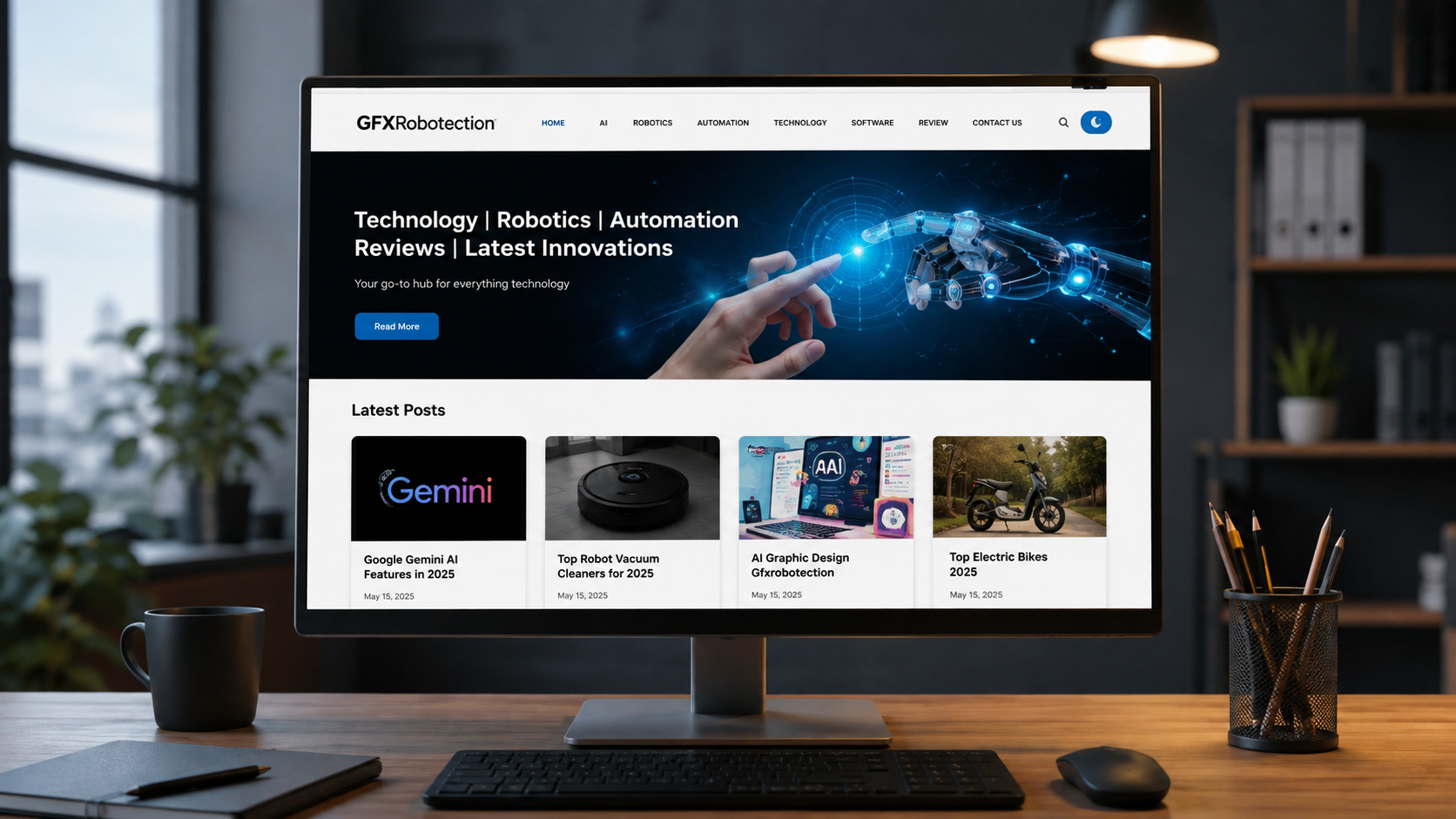
The phrase AI Graphic Design GFXRobotection can easily make it sound as though GFXRobotection is a standalone artificial-intelligence design application. Current evidence points to something more limited: gfxrobotection.com is primarily a technology and information website, not a clearly documented AI graphic-design software platform. Its homepage describes the site as a hub covering technology innovations, robotics, automation, software trends, gadget reviews, and practical technology applications. It also lists “AI Graphic Design Gfxrobotection” among its recent posts.
That distinction matters. Online articles increasingly describe “GFXRobotection” as an AI design and digital-art protection product associated with GFXMaker, sometimes claiming capabilities such as invisible fingerprinting, web monitoring, automated copyright detection, layout generation, and AI-assisted design. However, I could not independently verify a public software download, functioning product dashboard, technical documentation, consistent pricing page, app-store listing, or established third-party product testing that confirms those claims.
So the most useful way to review AI Graphic Design GFXRobotection is not to repeat those product claims as fact. It is to examine what the actual website currently shows, what can be verified, and where the information stops.
What Is GFXRobotection?
GFXRobotection.com currently presents itself as a broad technology content platform. The site says it is based in Huntsville, Alabama, identifies Lorissa Ollvain as its founder, and publishes material covering technology, robotics, automation, software development, gadgets, practical applications, and expert insights. Its homepage currently displays 14 recent posts, including topics such as “Graphic Design Gfxrobotection,” “Digital Craft Gfxrobotection,” “Gfxrobotection Ai Software by Gfxmaker,” “Graphic Design Software Gfxrobotection,” and the exact topic “Ai Graphic Design Gfxrobotection.”
That structure looks much more like a publishing website than the front page of a commercial design application. There is no obvious public workflow on the homepage for creating an account, opening a design editor, generating an image, downloading desktop software, or purchasing an AI design subscription. The navigation instead emphasizes informational categories and articles.
The important distinction: website versus software
This is the central issue for anyone searching the keyword.
A website can publish tutorials about AI graphic design without actually being the provider of the AI technology being discussed. Likewise, an article mentioning “GFXRobotection AI software by GFXMaker” does not by itself establish that a commercially available software product exists.
Independent pages discussing the subject make very different claims. Some describe GFXRobotection as a combined AI design and digital-rights platform, while others explicitly note that the underlying software, pricing, technical documentation, and major protection features could not be independently verified.
That inconsistency is the strongest reason to treat the term cautiously.
What the GFXRobotection Website Actually Offers
The current site provides informational content rather than a clearly documented AI editor.
Its stated categories include:
- Technology innovations
- Robotics and automation
- Software development
- Gadget reviews
- Practical technology applications
- Expert insights
The website also promotes a “Tech Expert Knowledge Vault” focused on areas such as AI, cybersecurity, software engineering and cloud computing. It describes editorial and research activities as part of the platform.
This makes GFXRobotection potentially useful as a technology information site, particularly for readers looking for articles around AI, software and digital creativity. It does not, based on the current public presentation, establish itself as an alternative to established graphic-design applications.
Does GFXRobotection Really Provide AI Graphic Design?
This is where expectations should be moderated.
Third-party articles use AI graphic design GFXRobotection to describe a supposed workflow in which AI generates design concepts while another layer protects the resulting artwork. Reported features include layout suggestions, colour generation, design variations, invisible digital fingerprinting, ownership metadata, batch processing and monitoring for copied artwork.
Those are potentially valuable capabilities, but they should currently be regarded as reported or claimed features rather than independently established product capabilities.
The public GFXRobotection website itself does not provide enough product documentation to establish that a visitor can sign in to an AI design editor and use all of those functions. The homepage’s structure, categories and recent posts point toward editorial publishing rather than a mature SaaS product.
That does not prove that no underlying project or product exists. It simply means the public evidence is insufficient to evaluate it as one would evaluate a normal commercial software service.
What About GFXMaker?
The GFXMaker connection is another area where readers should distinguish between editorial content and independently verifiable product infrastructure.
GFXMaker.com describes itself as a creative and technology hub covering graphic design, technology, software, Adobe tools and 3D printing. Its About Us page describes the site in publishing terms and lists editors rather than presenting a conventional software-company product structure.
GFXMaker also publishes articles specifically discussing GFXRobotection. Some of those pages portray it as an AI-powered creative or asset-protection system. Yet the public information does not provide the kind of technical evidence normally expected from established commercial software: detailed documentation, a stable product dashboard, release history, public API information, or a transparent pricing structure.
This is why it would be premature to describe GFXRobotection as a proven competitor to established design platforms.
How Useful Is GFXRobotection for Graphic Designers?
As a source of technology-related information, the site may be useful for readers interested in AI, digital design, automation and related subjects.
As a verified design application, however, the public evidence is much weaker.
A designer looking for an actual working AI design environment normally needs clear answers to practical questions:
Can I sign up?
What formats can I import and export?
Which AI models are used?
How much does it cost?
Who owns generated output?
Is commercial use allowed?
Where are uploaded files stored?
Can projects be deleted?
Is there a desktop or mobile application?
How does the claimed protection technology actually work?
Those questions remain insufficiently answered for GFXRobotection through the currently available public evidence.
GFXRobotection and Digital Artwork Protection
Artwork protection is a legitimate problem, particularly as designers increasingly distribute work through websites, social networks, client portals and online marketplaces.
The GFXRobotection discussion frequently centers on three familiar approaches: watermarking, access control and ownership records. That broader framework is sensible, but it should not be confused with proof that GFXRobotection itself provides every one of those technologies.
Visible watermarks can discourage casual copying but do not make an image impossible to steal. Access-controlled delivery can reduce unwanted sharing, while copyright registration provides a different type of protection: a legal record rather than a technical barrier.
For U.S. creators, the Copyright Office currently lists a standard online copyright-registration fee of $65, while certain eligible single-author claims can qualify for a lower $45 fee.
The important lesson is that copyright protection, watermarking, DRM and AI detection solve different problems. A software article that groups them together should not be interpreted as saying one tool automatically replaces all of them.
Privacy and Security: What Should Users Notice?
GFXRobotection does have a published privacy policy, but it is primarily written in the format of a conventional WordPress website privacy notice.
The policy says that comments can involve collection of information such as the submitted comment, IP address and browser user-agent information. It also discusses cookies, embedded third-party content, account information, deletion requests and automated spam detection.
One detail is particularly relevant to designers: the privacy policy discusses visitors uploading media to the website and warns about embedded EXIF location information. That is normal privacy advice for image-heavy websites, but it does not amount to documentation of a secure AI artwork-processing environment.
For that reason, designers should be careful about uploading valuable unreleased client work until they can verify exactly where files are processed, how long they are retained, whether they are used for model training, and how deletion works.
Trust and Transparency Review
GFXRobotection has several basic transparency elements that are useful to see on a technology website. It identifies a founder, names several writers, provides an email address and telephone number, gives a physical address, and publishes a privacy policy.
At the same time, those signals should not automatically be treated as proof that an associated software product is established or independently validated.
An important issue is the gap between the site’s presentation and the broader claims made online. The website describes itself as a hub for technology knowledge, whereas various external articles describe GFXRobotection as a sophisticated AI design-protection platform. That difference is significant for anyone intending to upload commercial artwork or pay for software.
The public address is also difficult to independently corroborate through readily available web results. That does not by itself establish wrongdoing, but it means the address should not be treated as independently verified corporate-registration evidence.
How It Compares With Established AI Design Tools
The contrast becomes clearer when the keyword is compared with established products.
Canva currently offers an extensive AI design environment through Canva AI and related tools, including prompt-based creation, editable layouts, AI-powered templates, image generation, photo editing, brand-aware design features and resizing.
Adobe Firefly is similarly documented as an active generative-AI creative platform for generating and editing images, videos and vector graphics, with a substantial public product ecosystem and documented features.
That does not necessarily mean Canva or Adobe is “better” for every task. It demonstrates something more basic: their products are publicly documented well enough for users to understand what they are actually buying or using.
GFXRobotection does not currently reach that same level of publicly verifiable software documentation based on the evidence available.
Pros and Cons of AI Graphic Design GFXRobotection
Potential strengths
The website covers a broad range of modern technology subjects and gives particular attention to AI, robotics, software and digital protection. The exact keyword appears within its published content, so people searching for the topic can find contextual information there.
The site also provides basic contact and privacy information and maintains identifiable editorial categories and author profiles.
Main weaknesses
The biggest limitation is product transparency. There is not enough public evidence to independently confirm GFXRobotection as a fully operational AI graphic-design application.
There is also no clearly established public pricing model, software download process, technical specification, product documentation or independently tested feature set.
Most importantly, claims about sophisticated artwork-protection functions should not be accepted merely because multiple websites repeat them. Several third-party discussions themselves acknowledge that these capabilities remain difficult to independently verify.
Is AI Graphic Design GFXRobotection Legit?
The careful answer is that gfxrobotection.com is an active website, but the evidence does not currently justify treating GFXRobotection as a fully verified commercial AI graphic-design software product.
Calling the website “fake” would go beyond the evidence. Likewise, calling it an established AI software platform with advanced protection technology would also go beyond what can currently be verified.
A more accurate assessment is:
The website exists and publishes technology content; the larger software claims associated with GFXRobotection remain insufficiently documented for independent confirmation.
That distinction is especially important when money, confidential client artwork or intellectual-property rights are involved.
Who Should Use or Read GFXRobotection?
For someone researching AI graphic design concepts, digital protection, robotics or technology trends, the website can be approached as an informational resource.
For someone actively searching for an AI image or graphic-design application, it makes more sense to evaluate products that provide a clear editor, documented features, transparent terms, public pricing information and a demonstrable workflow.
Professional designers should be particularly cautious about uploading unreleased client assets to an inadequately documented platform. Before doing so, they should verify ownership terms, training policies, retention periods, deletion controls and commercial-use rights.
Final Verdict
AI Graphic Design GFXRobotection is best understood as a search topic associated with the GFXRobotection technology website, rather than as a clearly verified standalone AI graphic-design application.
The website itself is active and presents technology-related articles covering AI, software, robotics, automation and digital creativity. It lists the exact AI graphic-design topic among its recent posts.
However, the more ambitious descriptions found elsewhere — particularly claims about integrated AI design, invisible artwork fingerprinting, automated web monitoring and comprehensive copyright protection — are not supported by enough publicly accessible product evidence to treat them as confirmed capabilities.
For readers, the safest conclusion is therefore straightforward: read GFXRobotection as an information website unless and until a clearly documented, independently verifiable software product becomes available. For actual AI graphic creation today, established platforms with publicly documented editors and features provide a much easier basis for comparison.
Frequently Asked Questions
Is GFXRobotection an AI graphic-design software?
The website itself is clearly an informational technology platform. Online articles describe a GFXRobotection AI software concept, but a fully documented standalone design application could not be independently verified.
Is GFXRobotection owned by GFXMaker?
Online articles associate the two names, and GFXMaker publishes content about GFXRobotection. However, the public evidence reviewed does not provide enough independent corporate or product documentation to conclusively establish a conventional software-company relationship.
Does GFXRobotection have AI image-generation features?
AI-assisted design capabilities are described in several online articles, including layout generation and creative variations, but those capabilities should currently be treated as reported claims rather than independently demonstrated product features.
Does GFXRobotection protect artwork from theft?
Articles associated with the term describe watermarking, fingerprinting, ownership metadata and monitoring functions. The existence and effectiveness of a dedicated GFXRobotection protection system, however, could not be independently confirmed.
Does GFXRobotection have public pricing?
A reliable public pricing schedule for the purported software could not be verified.
Should designers upload valuable client artwork?
It is better to wait until the product’s file-storage, privacy, training, retention, deletion and ownership policies are clearly documented. For commercially sensitive work, lack of documentation is itself an important limitation.
What are established alternatives for AI graphic design?
Canva AI currently provides a broad AI-assisted design workflow, while Adobe Firefly provides documented generative tools for images, video and vector graphics.
Also Read: GFXRobotection AI Software by GFXMaker | What’s Actually Verified in 2026

1 Comment
Pingback: Which iPad Should I Buy for Digital Art GFXRobotection