

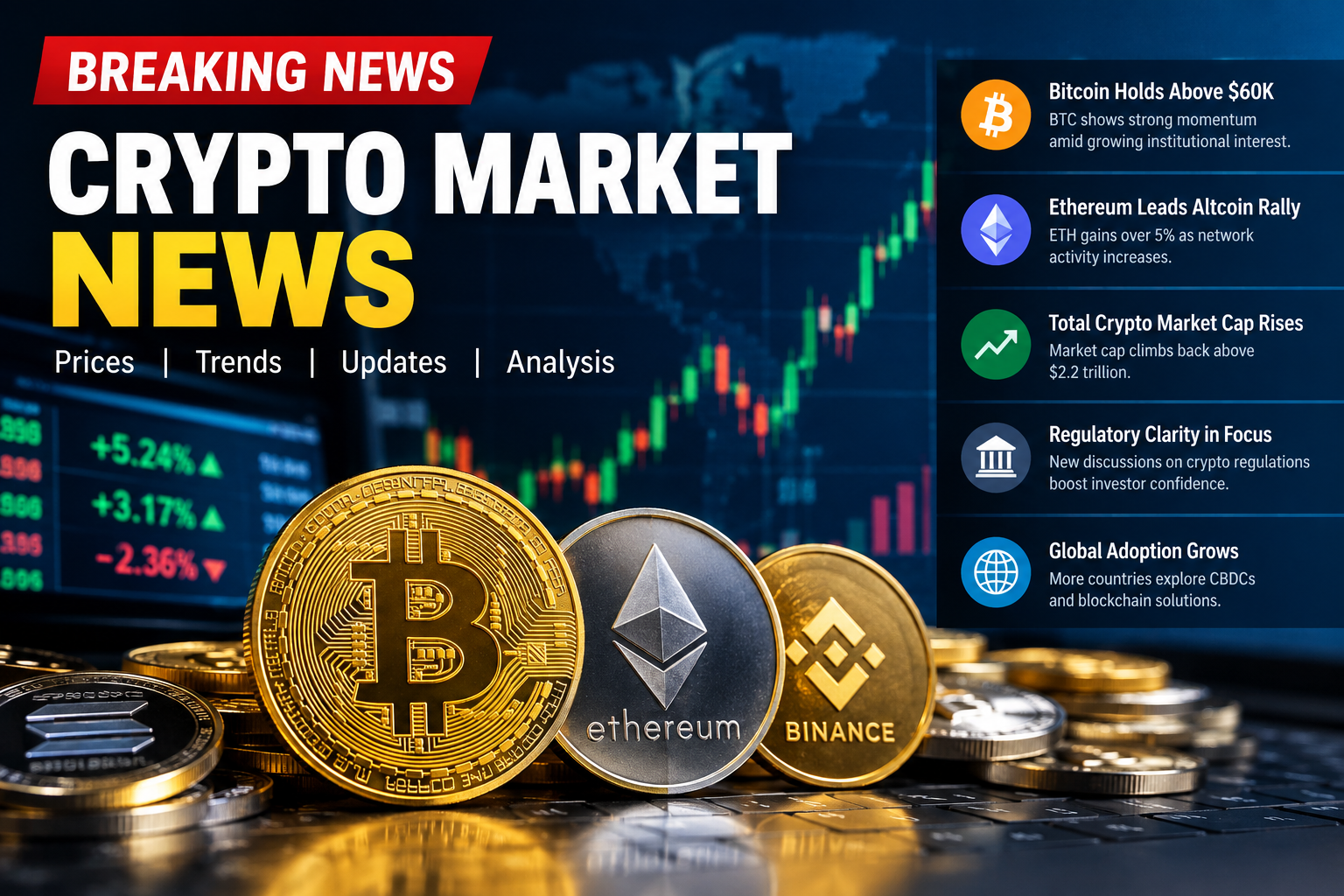
The cryptocurrency market is experiencing another important week as investors react to changes in U.S. monetary policy, regulatory uncertainty, and renewed activity across major digital assets. Bitcoin remains around the $76,000 level after experiencing sharp volatility earlier in the week, while Ethereum and several major altcoins are also attracting attention. At the same time, developments surrounding U.S. crypto legislation and institutional participation are becoming increasingly important for the broader market.
Bitcoin Remains Near $76,000
Bitcoin opened Thursday, September 17, at approximately $76,144, according to market data reported by Yahoo Finance. The cryptocurrency was trading higher than its previous opening level as investors responded to developments in global financial markets.
Bitcoin had previously climbed above $80,000 earlier in September, but the rally lost some momentum. The decline came as traders became more cautious about interest rates, regulation, and overall liquidity conditions. Despite the pullback, Bitcoin has remained well above several levels seen earlier in the year.
The current market shows that Bitcoin is being influenced by both traditional financial markets and crypto-specific developments. Investors are closely watching interest-rate expectations, institutional demand, exchange-traded funds, and regulatory decisions.
Federal Reserve Rate Hike Adds to Market Uncertainty
One of the biggest developments this week was the U.S. Federal Reserve’s decision to raise its benchmark interest rate by 25 basis points to a range of 3.75% to 4.00%. It was the Fed’s first rate increase in more than three years.
Higher interest rates can create challenges for risk-sensitive assets because investors may become more interested in traditional assets that offer higher yields. Cryptocurrency markets have historically reacted strongly to changes in global liquidity and interest-rate expectations.
However, Bitcoin moved higher following the latest Fed decision rather than experiencing an immediate major sell-off. This demonstrates that crypto prices can respond to several factors at the same time. Traders are now looking at whether additional rate increases could take place before the end of 2026.
The combination of monetary tightening and continued institutional interest means the crypto market could remain volatile in the coming weeks.
U.S. Crypto Regulation Remains a Major Issue
Regulation is another major factor affecting cryptocurrency prices. On September 15, the U.S. Senate failed to advance the CLARITY Act after a 49–50 procedural vote. The legislation was designed to establish a clearer regulatory framework for digital assets, but disagreements over ethics restrictions and other provisions prevented it from moving forward.
The failed vote initially contributed to selling pressure across the cryptocurrency market. Bitcoin, Ethereum, XRP, and other digital assets declined as traders reassessed the possibility of near-term regulatory clarity.
The development is significant because clearer rules could affect cryptocurrency exchanges, token issuers, decentralized finance platforms, and institutional investors. However, the legislation’s failure does not necessarily mean that U.S. crypto regulation will stop developing. Regulatory agencies and lawmakers can continue working on different approaches.
Ethereum and Altcoins Remain in Focus
Ethereum is also attracting significant attention. As the second-largest cryptocurrency by market capitalization, Ethereum’s performance is closely watched by traders and investors.
Recent market reports have placed Ethereum around the $2,400–$2,500 area, with prices responding to broader market volatility and regulatory developments.
Beyond Ethereum, several altcoins have shown strong individual price movements. Zcash, for example, has significantly outperformed Bitcoin during 2026 and recently reached a new record high, according to Stocktwits. The broader crypto market also recovered above a $2.7 trillion market capitalization level after falling below it ahead of the Federal Reserve decision.
This shows that cryptocurrency performance is becoming increasingly diverse. While Bitcoin and Ethereum remain dominant, investors are also monitoring projects connected to payments, tokenized assets, decentralized applications, and blockchain infrastructure.
Institutional Participation Continues
Institutional involvement remains another important theme in the cryptocurrency market. Bitcoin exchange-traded funds have provided traditional investors with easier access to Bitcoin without requiring them to directly manage cryptocurrency wallets.
However, ETF flows have also shown signs of volatility. U.S. spot Bitcoin ETFs recorded approximately $450.4 million in outflows on September 15, their largest daily outflow since June, according to market reports.
At the same time, institutional infrastructure continues to expand. Russia’s Moscow Exchange, for example, plans to launch perpetual futures linked to Bitcoin, Ethereum, Solana, XRP, and Tron indexes on September 22 for qualified investors.
These developments indicate that financial institutions and regulated exchanges continue to build products around digital assets despite short-term market uncertainty.
What Comes Next for the Crypto Market?
The next few weeks could be important for cryptocurrency investors. Traders are likely to focus on Bitcoin’s ability to remain above recent support levels, Ethereum’s performance, ETF flows, and developments surrounding U.S. digital-asset regulation.
Another event worth watching is the scheduled expiration of a large amount of Bitcoin and Ethereum options on September 25. Approximately $16.6 billion in options are reportedly set to expire, including around $14.63 billion in Bitcoin options and $1.93 billion in Ethereum options.
Overall, the crypto market is entering a period where monetary policy, regulation, institutional demand, and market liquidity are all interacting. Bitcoin remains near $76,000, while Ethereum and several altcoins continue to experience significant price movements.
For investors and market observers, the current environment highlights an important characteristic of cryptocurrency: prices can change quickly in response to both crypto-specific news and developments in the wider global economy. As regulatory discussions continue and financial institutions expand their involvement, the cryptocurrency market is likely to remain a closely watched part of global finance.
