

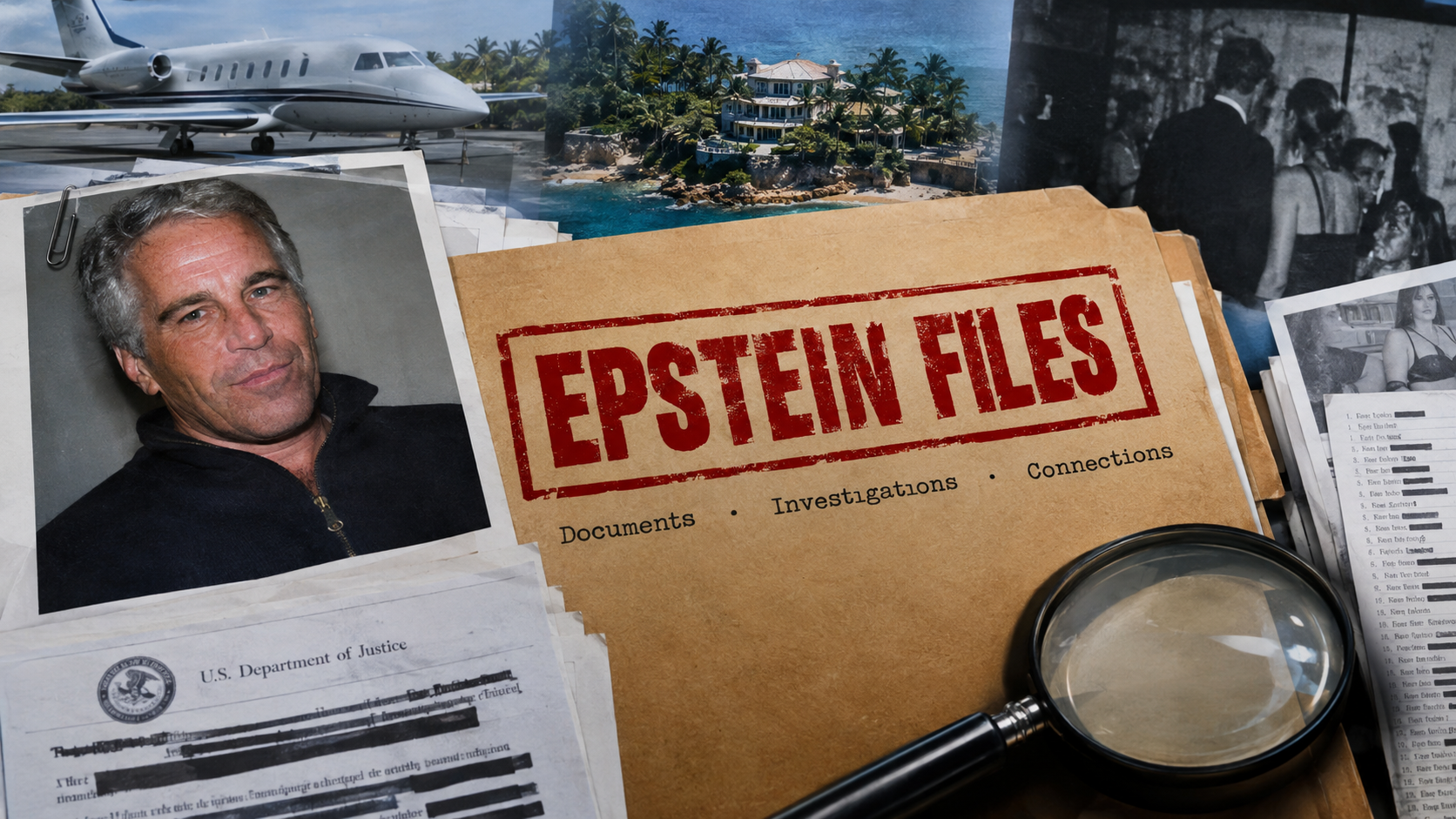
The Epstein files are a large collection of government records, court documents, investigative materials, emails, photographs, videos, flight records and other evidence connected to Jeffrey Epstein and related investigations. As of October 2026, the U.S. Department of Justice says its public Epstein Library contains millions of pages of material released under the Epstein Files Transparency Act, but the records should not be treated as a single verified “client list.”
The files matter because they document the investigations surrounding Epstein, his associates, his victims, his movements and his death, while also showing how people and institutions interacted with him. At the same time, a person’s name appearing in an Epstein-related document does not, by itself, establish criminal conduct.
What Are the Epstein Files?
The term “Epstein files” refers broadly to records generated or collected during investigations and legal proceedings involving Jeffrey Epstein, Ghislaine Maxwell and other related matters. The material comes from multiple sources rather than one master document.
According to the DOJ, the released material was collected from sources including the federal cases against Epstein in Florida and New York, the prosecution of Ghislaine Maxwell, investigations into Epstein’s death, a Florida investigation involving a former Epstein employee, multiple FBI investigations and an Office of Inspector General investigation.
The records can include:
- FBI investigative files
- Court filings and exhibits
- Flight logs and travel records
- Contact books
- Emails and correspondence
- Photographs and videos
- Evidence inventories
- Interview records
- Prison and custody records
- Materials relating to Epstein’s death
- Records concerning Ghislaine Maxwell
- Government communications about investigative and disclosure decisions
Because the collection contains material created at different times and for different purposes, individual documents must be evaluated in context.
Why Were the Epstein Files Released?
A major change came with the Epstein Files Transparency Act, formally enacted as H.R. 4405, Public Law 119-38, on November 19, 2025. The law required the Attorney General to make specified unclassified Epstein-related records publicly available in a searchable and downloadable format, subject to legally permitted protections.
The law covers substantially more than names or flight logs. It encompasses records concerning Epstein, Ghislaine Maxwell, travel records, individuals and entities referenced in connection with Epstein’s alleged criminal activities, immunity and plea arrangements, internal DOJ communications and certain records concerning the handling or destruction of investigative material.
This legislation transformed the release of Epstein-related records from a series of individual disclosures into a broader statutory transparency process.
When Did the Major Epstein Files Releases Happen?
The public record has developed through several stages.
| Date | Development |
|---|---|
| February 27, 2025 | DOJ announced its first phase of declassified Epstein-related files, including flight logs, a redacted contact book and a redacted masseuse list. |
| July 2025 | DOJ and FBI released a memorandum describing the results of an extensive review of investigative holdings. The memo said investigators found no incriminating “client list.” |
| November 19, 2025 | The Epstein Files Transparency Act became law. |
| December 2025 | DOJ began publishing records under the new transparency law. |
| January 30, 2026 | DOJ announced publication of more than 3 million additional pages, bringing the total production to nearly 3.5 million pages, alongside more than 2,000 videos and 180,000 images. |
| September 2026 | DOJ’s Epstein Library remained publicly available and had been updated as recently as September 11, 2026. |
The scale of the January 2026 publication was particularly significant. DOJ said the material represented nearly 3.5 million pages released in compliance with the law.
What Do the Epstein Files Actually Reveal?
The documents provide a much broader picture than a list of famous people.
They help establish the extent of the government’s investigations, Epstein’s extensive social and professional contacts, his travel patterns, communications involving associates and the investigative history surrounding his criminal activity.
The files also show that Epstein had connections or interactions with numerous prominent individuals. However, association is not equivalent to participation in a crime. A person can appear in a contact book, photograph, email, calendar entry or flight record without the document establishing that the individual participated in Epstein’s criminal conduct.
That distinction is essential when interpreting the files.
Flight Logs and Travel Records
Flight records have received enormous public attention because they can document who traveled on aircraft associated with Epstein and where those aircraft traveled.
The DOJ’s February 2025 release specifically included flight logs previously introduced in the Maxwell case.
But a flight record generally establishes a travel connection, not the purpose of a trip or whether a passenger knew about criminal activity. Any stronger conclusion requires additional evidence.
Contact Books
Epstein’s contact information has also become a major focus of public discussion.
The first DOJ release included a redacted contact book.
A contact entry can show that someone’s information was present in Epstein’s records, but it does not independently prove a close relationship, participation in trafficking or knowledge of his crimes.
Photographs, Emails and Other Communications
The larger releases contain photographs, correspondence and other records that can provide additional context about Epstein’s relationships and activities.
These materials are particularly important because a single document can be incomplete or ambiguous. An email may establish communication without explaining everything that happened outside the correspondence, while a photograph can demonstrate that people met without establishing what they discussed.
Is There an Epstein “Client List”?
This is one of the most important questions surrounding the files, and the answer requires careful wording.
In a July 2025 memorandum, the DOJ and FBI said their review found no incriminating “client list.” The same memorandum said investigators found no credible evidence that Epstein blackmailed prominent individuals and no evidence that would justify opening investigations against uncharged third parties based on the material they reviewed.
Ghislaine Maxwell also told DOJ during a 2025 interview that she was not aware of an Epstein “list” of the type discussed publicly. Her interview transcript is included in the DOJ’s released material.
This does not mean that Epstein had no records containing names. The released files clearly include contact information, travel records and references to many people. The key distinction is between a collection of names appearing throughout investigative records and a verified government document identifying people as Epstein’s criminal “clients.”
Those are not the same thing.
Does Appearing in the Epstein Files Mean Someone Committed a Crime?
No.
This is perhaps the most important rule for reading the documents responsibly. A person’s name can appear because they were a contact, employee, witness, victim, acquaintance, investigator, passenger, correspondent or subject of an allegation.
The DOJ itself has warned that the released production can contain material submitted to the FBI by members of the public that may be false or fabricated. The department specifically noted that responsive material could include fake or falsely submitted images, documents or videos.
Therefore, readers should distinguish between:
Documented fact: A person’s name appears in a particular record.
Allegation: Someone made a claim about that person.
Evidence: Investigators obtained material supporting or contradicting a claim.
Finding: A court or competent authority established a fact through a legal or investigative process.
Treating all four categories as identical can create serious misinformation.
Why Are Some Epstein Files Redacted?
The records contain highly sensitive information, including information identifying victims and material involving sexual abuse.
DOJ says it applied redactions to protect victim names and other identifying information. It also warns that some material may inadvertently contain sensitive information because of the enormous size of the production.
The law itself permits restrictions on certain categories of information. The objective of the transparency process therefore is not simply to publish every piece of information without restriction. It also requires protection of victims, legally protected information and other material that cannot lawfully be disclosed.
The DOJ’s library also warns that portions of the collection contain descriptions of sexual assault and may not be appropriate for all readers.
Why Is the Epstein Library So Large?
The sheer size of the collection reflects the fact that the files were gathered over many years and from multiple investigations.
The January 2026 DOJ announcement said the new publication alone contained more than 3 million additional pages, over 2,000 videos and approximately 180,000 images. Combined with previous releases, the department described the total production as nearly 3.5 million pages.
The library also incorporates previously released FOIA records and earlier DOJ disclosures. Its categories include FBI records, Bureau of Prisons material, Florida records, prior declassified files, Maxwell material and memoranda and correspondence.
That means searching the collection is more like examining a large archive than reading one conventional report.
How Should You Read the Epstein Files?
The best approach is to evaluate each document according to its source and context.
1. Identify the type of document
Determine whether you are looking at a court filing, FBI record, email, photograph, interview, allegation, evidence inventory or another type of material.
2. Check the date
A document from before Epstein’s 2008 Florida conviction has a different context from a document created during the 2019 federal prosecution or after his death.
3. Separate allegations from findings
Investigative files often contain accusations that were never proven. The presence of an allegation in an FBI file does not make the allegation true.
4. Look for corroboration
Important claims should be compared with other records, court documents, official statements or credible reporting.
5. Avoid guilt by association
A name appearing in an address book or flight log is not proof of criminal activity.
6. Protect victims
Do not republish private identifying information about victims or other people whose information appears in investigative material.
The DOJ’s own search system warns that technical limitations, including handwritten documents, mean that some material may not be searchable reliably.
What Is the Difference Between the Epstein Files and Court Records?
The terms are often used interchangeably, but they are not identical.
Court records are documents filed in judicial proceedings. They can include pleadings, motions, exhibits, rulings and other materials formally submitted to a court.
Epstein files is a broader public term covering government investigative records, court records, FOIA material, correspondence, evidence and other documents connected with Epstein-related investigations.
The federal Southern District of New York maintains information concerning the Epstein and Maxwell cases through its court-record system, while the DOJ’s Epstein Library brings together a much broader collection of released government material.
What Remains Uncertain?
Despite the enormous volume of released information, the files do not automatically answer every question surrounding Epstein.
Some records remain subject to redaction or legal restrictions, particularly where victims’ privacy or other protected interests are involved. The DOJ has also acknowledged that the collection contains material submitted by outside parties that may be false or unverified.
There is also an important distinction between what investigators found and what internet users claim the documents prove. The existence of millions of pages makes selective screenshots and isolated quotations especially vulnerable to misleading interpretation.
The most reliable understanding therefore comes from reading documents in their original context and comparing them with court findings and official investigative records.
Where Can You Read the Epstein Files?
The most authoritative starting point is the U.S. Department of Justice Epstein Library, which provides access to DOJ disclosures, House disclosures and a searchable collection of released material.
U.S. Department of Justice Epstein Library
Readers should prefer the original government documents whenever possible rather than relying on screenshots, anonymous social-media posts or unofficial databases that may remove context from the underlying records.
Frequently Asked Questions About the Epstein Files
What are the Epstein files?
The Epstein files are a broad collection of government, investigative and court-related records connected to Jeffrey Epstein, Ghislaine Maxwell and related investigations. They include documents such as flight logs, communications, photographs, FBI records, evidence inventories and court materials.
Are the Epstein files fully public?
A very large volume has been released, but not every piece of information is necessarily public or unredacted. DOJ says it has redacted victim-identifying information and other legally protected material, while some records can remain subject to legal restrictions.
Is there a verified Epstein client list?
The DOJ and FBI said in their July 2025 memorandum that their review found no incriminating “client list.” The existence of numerous names in Epstein-related records should not be confused with a government-verified list of people who participated in crimes.
Does being named in the Epstein files prove wrongdoing?
No. A person may appear in a contact book, travel record, photograph, email, witness statement or other document for many reasons. Additional evidence is necessary before concluding that someone committed a crime.
How many Epstein documents have been released?
On January 30, 2026, the DOJ said it had published more than 3 million additional pages and that the total production was nearly 3.5 million pages, alongside more than 2,000 videos and 180,000 images.
Where can I find the official Epstein files?
The official collection is hosted by the U.S. Department of Justice in its Epstein Library. The library includes DOJ disclosures and other publicly released Epstein-related records
Also read: My Skarsgård
