

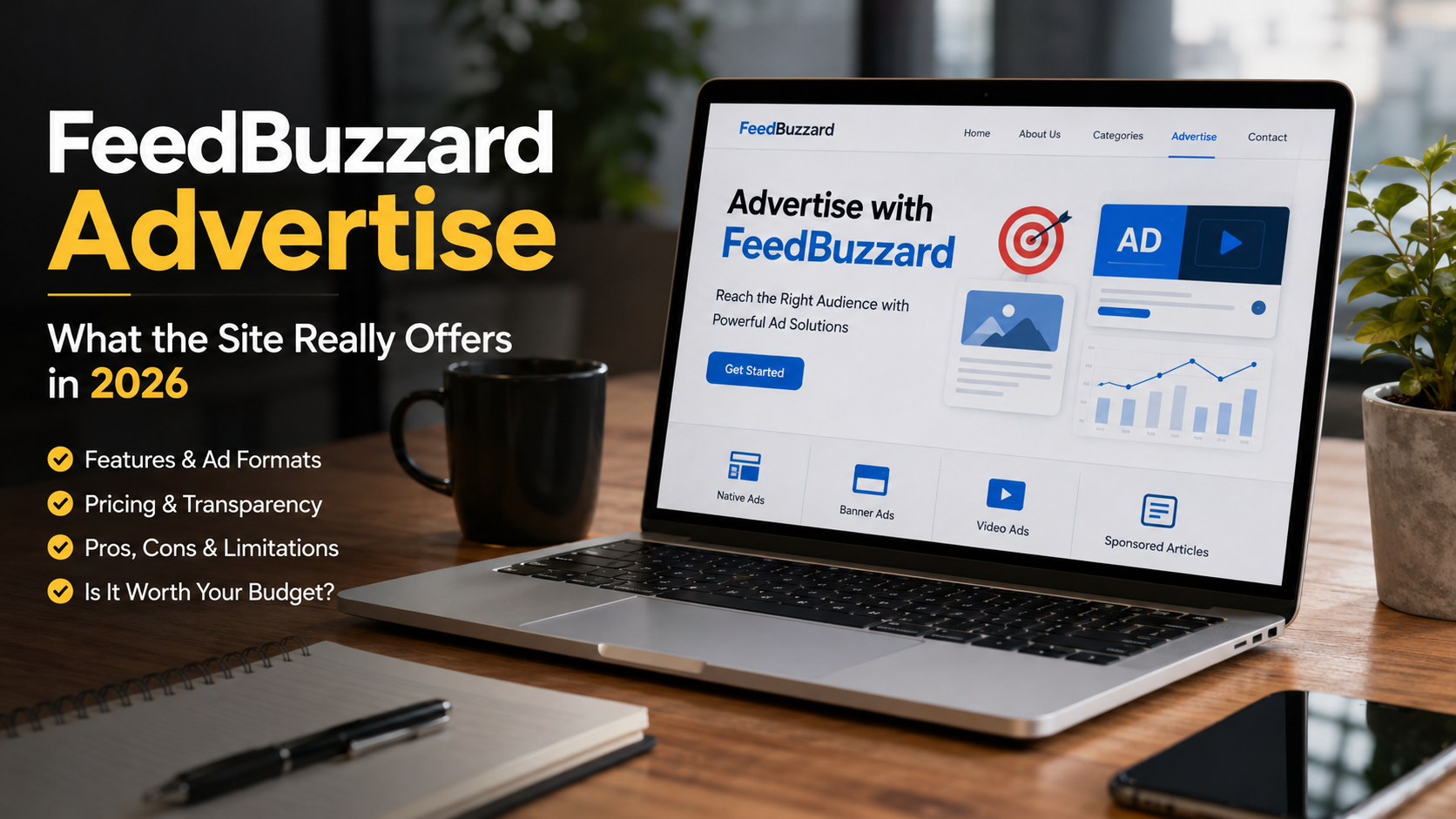
Searching for FeedBuzzard Advertise can be confusing because FeedBuzzard.com publishes several pages describing advertising capabilities, but the public website does not clearly present a conventional self-service advertising platform with an identifiable advertiser dashboard, published rate card, or independently verifiable campaign metrics.
FeedBuzzard.com is currently presented primarily as a technology and digital-content publication. Its About Us page says the site focuses on technology, global technology trends, and wearable technology. Its homepage also carries articles spanning technology, gaming, business, general-interest subjects, and other categories.
The most important point for advertisers is therefore this: FeedBuzzard does discuss advertising on its own site, but the publicly verifiable evidence does not establish it as a mature, transparent ad network comparable with Google Ads, Meta Ads, or established native-ad platforms.
What Is FeedBuzzard?
FeedBuzzard.com currently operates as a content website rather than a clearly documented advertising technology company. The site’s official About Us page describes it as a blog covering tech, world technology, and wearable technology.
Its homepage shows a broader editorial mix in practice, including technology, business, gaming, online gaming, wearable technology, general news, and other topics. Recent pages include articles published during 2026, indicating that the domain is still active.
The domain itself is not new. WHOIS records show that feedbuzzard.com was registered on November 27, 2020, with GoDaddy listed as registrar and privacy protection applied to the registrant information.
That domain age should not, however, be confused with proof of a long-established advertising business. The publicly visible site does not provide enough evidence to establish how long formal advertising services have been offered.
What Does “FeedBuzzard Advertise” Actually Mean?
The phrase appears to have become a search term around FeedBuzzard’s advertising-related content rather than the clearly documented name of a standalone advertising product.
FeedBuzzard has published pages such as “How To Advertise On FeedBuzzard” and “Advertising FeedBuzzard.” The June 18, 2026 advertising guide claims support for native cards, banners, videos, sponsored articles, targeting options, conversion tracking, and multiple pricing models including CPM, CPI, and CPC.
Those statements are important because they show what the site itself says about advertising. They should not automatically be treated as independently verified evidence that every claimed capability is operational today.
The same advertising guide describes a workflow in which advertisers supposedly create an account, verify billing, select objectives, choose targeting, upload creatives, set a budget, install conversion tracking, and submit campaigns for approval.
The difficulty is that the public-facing website does not provide enough corresponding infrastructure or documentation to independently confirm that this is functioning as a conventional self-serve ad platform.
FeedBuzzard Advertising Claims vs. Publicly Verifiable Evidence
The clearest way to evaluate the opportunity is to separate what FeedBuzzard says from what a prospective advertiser can actually verify.
The distinction matters. An advertising article can describe a proposed or available capability, but a buyer should ideally also be able to see the product interface, pricing, advertising terms, inventory details, traffic methodology, measurement documentation, and a clear commercial contact process.
What Advertising Formats Does FeedBuzzard Say It Supports?
The June 2026 guide says FeedBuzzard supports native cards, banner units, video spots, and sponsored articles. It also says placements can appear inside feed streams, on article pages, and within mobile apps.
Another FeedBuzzard article published in October 2025 describes the platform as supporting analytics, real-time tracking, customizable templates, multi-channel integration, personalization, and A/B testing.
However, those descriptions should be considered first-party claims rather than independently confirmed product specifications. There is a notable gap between the sophistication described in those pages and the simpler public presentation of FeedBuzzard.com as a content site.
For that reason, advertisers should request concrete implementation details before paying for a campaign.
Does FeedBuzzard Publish Advertising Prices?
This is one of the biggest limitations for anyone researching FeedBuzzard Advertise.
The June 2026 guide discusses CPM, CPI, and CPC pricing models, as well as daily budgets and campaign caps, but it does not provide a clear public price sheet showing verified minimum spend, CPM ranges, CPC rates, campaign fees, or standard placement costs.
That makes it impossible to give a reliable “FeedBuzzard advertising cost” figure without contacting the site directly.
Advertisers should be especially cautious about third-party articles that publish specific minimum deposits or fixed prices without showing a verifiable first-party pricing document. Search results contain articles claiming particular budget requirements and advertising models, but those figures are not sufficient evidence on their own.
Who Is FeedBuzzard Advertising Best Suited For?
Based on the site’s published material, the intended advertising audience appears to include businesses, marketers, agencies, publishers, and brands seeking exposure through digital content.
The site’s advertising guide specifically mentions small businesses, publishers, direct-to-consumer brands, and interest groups such as technology, finance, and lifestyle audiences.
That could make the site potentially relevant for a smaller campaign focused on visibility among readers interested in technology or related digital topics. It is much harder, however, to determine whether FeedBuzzard can provide the scale, targeting depth, attribution quality, or predictable conversion volume expected from an established advertising network.
For a niche experiment, that uncertainty may be manageable. For a large performance-marketing budget, it is a more significant concern.
How to Approach an Advertising Request
FeedBuzzard’s current Contact Us page provides an email contact and a web form. It asks users to mention feedbuzzard.com in the message and says that only relevant propositions may receive a response.
That means the practical route for a prospective advertiser appears to be direct contact rather than relying on a prominently documented public advertising portal.
A professional advertising inquiry should specify the website or brand being promoted, the intended audience, preferred placement, campaign duration, creative format, geographic market, desired objective, and approximate budget. The advertiser should then request a written proposal containing deliverables, costs, placement details, reporting, payment terms, cancellation rules, and any sponsored-content disclosure requirements.
Transparency and Ownership: What Can Be Verified?
FeedBuzzard’s public transparency has some weaknesses.
The About Us page identifies the publication’s subject areas but does not provide a clearly named corporate entity or detailed ownership history.
WHOIS records show that the domain is protected by a privacy service. The listed registrant information identifies “Registration Private” and Domains By Proxy rather than the underlying owner.
That is not, by itself, evidence that the website is illegitimate. Domain privacy is common. It does mean, however, that a buyer cannot use the public WHOIS record to independently establish the ultimate operator of the site.
There is also an unusual point regarding the website’s published address. FeedBuzzard lists 222 Haloria Crossing, Vrentis Point, HV 12345 on its About and Contact pages.
The same domain has published an article treating that address as a local geographic location, yet the public pages do not provide independent corporate-registration evidence connecting that address to an identifiable business entity.
For a company accepting advertising payments, advertisers should therefore verify the legal contracting entity and payment recipient before sending money.
Privacy and Website Policies
FeedBuzzard does provide a privacy policy and terms-and-conditions page.
Its privacy policy says the site can collect information from comments, cookies, embedded third-party content, and contact interactions, and it explains that third-party embedded websites may use their own tracking technologies.
The Terms & Conditions page states that the service is provided “as is” and “as available,” contains limitations of liability, and identifies the country in its definitions as Delaware, United States. The page also says it was last updated July 14, 2022, which is notably older than the site’s current 2026 content.
That outdated policy date is worth noting for commercial users. A business considering a paid advertising relationship should not assume that a general website terms page fully describes current advertising-specific contractual conditions.
One Important Red Flag: Advertising Claims Are More Detailed Than the Public Commercial Infrastructure
Perhaps the most important finding from this review is the mismatch between the sophistication of some advertising descriptions and the information publicly available to verify those claims.
FeedBuzzard’s 2026 advertising guide describes real-time bidding, first-party data, audience targeting, lookalikes, custom audiences, multiple billing models, conversion tracking, and fast approvals.
Yet the public site does not provide an easily verifiable advertiser product page with a transparent pricing schedule, audience documentation, publicly documented technology stack, independently audited reach figures, advertiser case-study evidence, or a clearly visible self-service campaign interface.
That does not prove the claims are false. It means a careful buyer should treat them as claims requiring confirmation before committing budget.
What About the Reported Case Studies?
The site has published examples describing highly positive advertising outcomes. One October 2025 article claims a fictionalized “TechStart” campaign increased ROI by 150% and says a “FashionStyle Co.” campaign achieved a 300% increase in engagement.
These should not be treated as independently audited performance statistics.
The article does not provide the type of detailed evidence a marketer would normally want for a verifiable case study, such as campaign spend, baseline figures, attribution methodology, conversion definitions, dates, screenshots from a campaign account, or an independently identifiable client source.
Accordingly, these figures are better understood as published promotional examples, not reliable benchmarks for what another advertiser should expect.
Is FeedBuzzard Advertise Legit?
The answer depends on what “legit” means.
FeedBuzzard.com is a real, active website with a registered domain, current content, published contact information, privacy documentation, and terms. Those are genuine trust signals.
At the same time, the public evidence is not strong enough to confirm FeedBuzzard as a transparent, established advertising network with independently verifiable audience scale and performance data.
Therefore, the most defensible conclusion is not that FeedBuzzard is fraudulent or that its advertising services do not exist. The stronger conclusion is that advertisers should perform additional due diligence before making a significant payment.
That distinction is important because there is insufficient evidence to support an accusation of wrongdoing.
Advantages of Advertising Through FeedBuzzard
One potential advantage is relevance. FeedBuzzard’s published editorial positioning is strongly connected to technology and digital topics, so a technology-oriented company could potentially benefit from contextual alignment.
Another advantage is flexibility. The advertising material describes several formats and targeting mechanisms, which could theoretically support both brand-awareness and direct-response campaigns.
The site is also active and continues publishing new material, giving advertisers a current publication environment rather than a dormant domain.
Finally, a direct publisher relationship can sometimes be more flexible than buying inventory through a huge automated network, particularly when a brand wants sponsored editorial exposure or a custom placement.
Limitations You Should Consider
The largest limitation is the lack of transparent public pricing. Advertisers cannot easily compare costs without opening a direct conversation with the site.
The second is limited independent evidence. There is little publicly verifiable information showing actual advertiser volume, audience size, campaign delivery, or independently measured return on advertising spend.
Another concern is transparency around the operating business. Domain registration is privacy-protected, while the website’s public corporate identity is limited.
The site’s legal documentation also deserves attention because its Terms & Conditions page shows a last-updated date of July 14, 2022, even though the website is actively publishing in 2026.
FeedBuzzard Advertise vs. Major Ad Platforms
FeedBuzzard should not automatically be compared with Google Ads, Meta Ads, or major programmatic networks on equal terms.
Those larger ecosystems generally provide mature campaign dashboards, extensive documentation, standardized billing, detailed reporting, large-scale audience systems, and substantial bodies of third-party information.
FeedBuzzard appears much closer to a publisher-level advertising opportunity, at least based on the public evidence currently available.
That can still be useful. A smaller publisher can offer contextual relevance or direct sponsorship opportunities that are difficult to reproduce through broad automated advertising. The trade-off is that buyers may have less standardized measurement and less publicly documented infrastructure.
How to Test FeedBuzzard Safely
A sensible approach would be to treat FeedBuzzard as a test opportunity rather than a proven high-scale performance channel.
Start by requesting a written advertising proposal. Ask for exact placement locations, campaign duration, audience geography, expected delivery model, pricing, reporting metrics, refund or cancellation conditions, and the legal name of the entity receiving payment.
Before making a meaningful commitment, request evidence that the proposed inventory actually exists. Screenshots of placements can help, but a live page or documented campaign workflow is stronger evidence.
For performance marketing, use your own analytics rather than relying solely on publisher-reported results. Track landing-page sessions, conversions, cost per acquisition, and assisted conversions independently.
For sponsored articles, pay particular attention to disclosure, editorial labeling, backlink terms, permanence of publication, and whether the arrangement complies with applicable advertising and search-engine guidelines.
Final Verdict
FeedBuzzard Advertise is best viewed cautiously as a possible direct-publisher advertising opportunity, not as a fully verified mainstream ad network.
The underlying FeedBuzzard.com website is active, its domain dates back to 2020, and the site publishes advertising-related material that describes multiple formats, targeting choices, and campaign processes.
However, several of the most important commercial details remain difficult to verify publicly. There is no clear public rate card, no strong independent evidence of audience scale or advertiser performance, limited corporate transparency, and advertising claims that are substantially more detailed than the site’s publicly demonstrable commercial infrastructure.
For a small experimental campaign, direct sponsorship, or a narrowly targeted technology audience, it may be worth investigating further. For a substantial advertising budget, the safer approach is to verify the inventory, legal counterparty, pricing, measurement system, and campaign reporting before committing funds.
In other words, FeedBuzzard.com is real and active, but the phrase “FeedBuzzard Advertise” currently carries more certainty in search results than the publicly verifiable advertising infrastructure justifies.
Frequently Asked Questions
Is FeedBuzzard Advertise an official product name?
Not clearly. FeedBuzzard publishes pages specifically discussing advertising, but the public site does not establish “FeedBuzzard Advertise” as a separately documented product or brand with a standard advertiser dashboard.
Does FeedBuzzard publish advertising prices?
The site discusses CPM, CPI, and CPC models but does not provide a dependable public rate card that establishes current advertising prices.
Can businesses contact FeedBuzzard about advertising?
Yes. The current Contact Us page provides an email contact and a submission form for inquiries and propositions.
Is FeedBuzzard.com an established advertising network like Google Ads?
The available public evidence does not support treating it as an equivalent to a major advertising ecosystem. FeedBuzzard is primarily presented as a content publication, while its advertising capabilities are described through site-published guides.
Who owns FeedBuzzard.com?
The underlying domain registrant is privacy-protected in public WHOIS records, which list Registration Private and Domains By Proxy. The site’s public pages do not provide enough information to independently establish the ultimate owner.
Should you pay for FeedBuzzard advertising immediately?
A cautious buyer should verify the advertising package, actual placement, pricing, legal contracting entity, payment recipient, and reporting system first. The available public evidence does not justify assuming that every advertised capability or performance claim has been independently validated.

2 Comments
Pingback: www FeedBuzzard com Review | What the Site Actually Is in 2026
Pingback: FeedWorldTech World Techie News by FeedBuzzard | What the Website Really Offers