

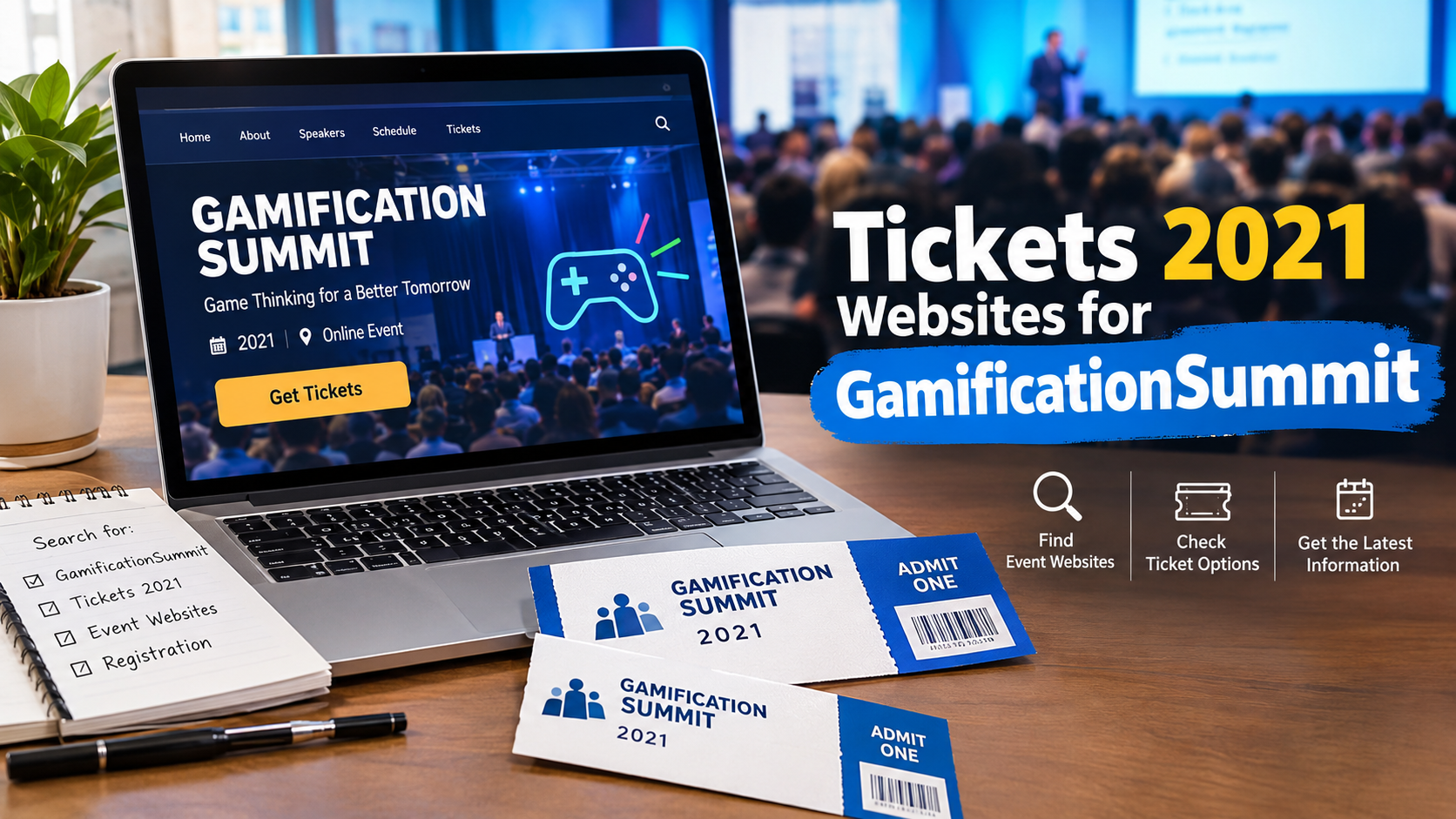
Tickets 2021 websites for gamificationsummit is a search phrase referring to websites, registration pages, and archived ticket information associated with a Gamification Summit event in 2021. However, current evidence does not independently verify a complete official ticketing record for a 2021 Gamification Summit, so old pages claiming specific ticket prices, vendors, or event details should be treated cautiously.
The Gamification Summit itself is well documented as a real industry event from the early 2010s. Contemporary sources recorded the first summit in San Francisco in January 2011 and a New York edition later that year.
What Does “Tickets 2021 Websites for GamificationSummit” Mean?
The keyword appears to combine several related searches: Gamification Summit tickets, 2021 ticket websites, registration information, and historical event pages.
Someone using this query today may be trying to find an old registration page, determine whether a ticket website was legitimate, research historical ticket prices, or locate information about the summit itself. Because 2021 is now a past event year, any page presenting itself as a place to purchase a 2021 ticket deserves additional scrutiny.
Search results currently contain several websites making detailed claims about a 2021 Gamification Summit, including claims about ticket tiers, prices, virtual attendance, and third-party ticket platforms. Those claims are not consistently supported by independent contemporary sources.
The History of the Gamification Summit
The Gamification Summit was an established conference focused on the use of game mechanics and engagement techniques outside traditional games.
Contemporary reporting confirms that the first Gamification Summit took place in San Francisco on January 20–21, 2011. Game Developer described it as the first summit dedicated to using game-like systems to encourage participation in non-gaming activities.
The event attracted people interested in marketing, product development, user engagement, behavioral design, and related areas. GamesBeat reported that the 2011 San Francisco summit featured case studies, workshops, keynotes, and panels involving prominent figures in the emerging gamification field.
The summit also expanded to New York in September 2011. O’Reilly’s contemporary event material identified Gabe Zichermann as chair of the Gamification Summit and promoted the September 15–16 New York event.
Why This History Matters
Understanding the earlier history helps distinguish a genuine historical Gamification Summit from websites that simply use the name today.
There is strong independent evidence for Gamification Summit events in 2011. Academic and industry sources also document the summit’s role in the early development of the professional gamification community.
What is considerably harder to establish is the exact relationship between those documented events and websites currently publishing articles about a supposed 2021 edition.
Was There a Gamification Summit in 2021?
This is the most important point for anyone researching the keyword.
Several websites published in 2025 and 2026 claim that a Gamification Summit took place online on November 9–10, 2021. Some also describe specific ticket tiers and prices. However, the searches conducted for this article did not uncover sufficient independent contemporary evidence from an organizer, established event archive, venue, major publication, or recognized ticketing record to independently confirm those details.
For example, one current website states that the 2021 summit was a virtual event held November 9–10, while another gives detailed General Admission and VIP prices. These are secondary claims published years after the alleged event, rather than contemporaneous documentation establishing the event.
That distinction matters. A webpage saying an event happened is not, by itself, proof that the event took place or that its ticketing information was authentic.
What Websites Are Associated With the 2021 Ticket Search?
Current search results mention several domains and platforms in connection with Gamification Summit 2021 ticket research.
| Website or platform | What current search results claim | Verification status |
|---|---|---|
| GamificationSummit.com | Main event or ticket information website | Historical relationship requires independent verification |
| Eventbrite | Claimed by some later pages as a ticket platform | Specific 2021 Gamification Summit listing not independently verified |
| Ticketmaster | Mentioned by later ticket-related pages | Specific 2021 Gamification Summit listing not independently verified |
| Meetup | Mentioned as a possible event/community discovery channel | Specific official 2021 ticket relationship not independently verified |
| GamificationSummit.net | Publishes articles about Gamification Summit tickets | Not evidence by itself that it was the 2021 official ticket seller |
| Other similarly named domains | Publish retrospective ticket information | Treat as secondary sources unless independently corroborated |
Some current articles explicitly list Eventbrite, Ticketmaster, Meetup, and other platforms as places associated with the 2021 ticket process. However, the evidence available does not establish that these platforms were officially authorized ticket sellers for a 2021 Gamification Summit.
Therefore, it would be misleading to present them as confirmed official ticket websites.
Why Old Ticket Pages Can Be Misleading
Historical event searches have a particular problem: old information can remain indexed long after an event has ended.
A page may contain the event name, ticket terminology, prices, registration instructions, and even a checkout-style interface. None of those elements automatically proves that the page was an official ticket portal.
The problem becomes greater when multiple websites use similar names. A domain containing “Gamification Summit” may look authoritative without having any documented connection to the original event organizer.
Domain Names Are Not Proof of Authenticity
A common mistake is assuming that a domain must be official because it contains the event’s name.
For example, the existence of gamificationsummit.com, gamificationsummit.net, or another similarly named website does not independently establish ownership, authorization, or historical ticketing rights.
A reliable verification process should establish the relationship between:
Organizer → Event → Official website → Ticket seller → Payment recipient
If that chain cannot be demonstrated, the ticket information should be considered unverified.
What About the Reported 2021 Ticket Prices?
Several current articles report prices such as approximately $299–$399 for General Admission and $599–$799 for VIP.
These figures should not be presented as confirmed historical prices without stronger primary evidence.
The same problem applies to claims about student discounts, group pricing, workshop add-ons, VIP consultations, referral bonuses, or particular refund deadlines. Current pages make these claims, but the available evidence does not establish them sufficiently as authentic 2021 pricing records.
For historical research, it is better to say that these prices have been reported by later websites rather than stating that they were definitely the official 2021 prices.
How to Verify a Historical Gamification Summit Ticket Website
If you encounter an old ticket page while researching this keyword, use several checks before trusting its information.
1. Check the Event Date
Determine whether the page is actually about 2021 or whether the year has been inserted into a newer article for SEO purposes.
A historical page should contain consistent dates throughout the page, including the event schedule, registration period, and publication context.
2. Identify the Organizer
Look for the legal or organizational identity behind the event.
A credible event record should make it possible to determine who organized the summit and how that organization relates to the website selling tickets.
3. Look for Contemporary Evidence
Contemporary evidence is considerably more useful than an article published years later.
Useful evidence includes:
- Archived event announcements
- Original organizer announcements
- Contemporary news coverage
- Venue records
- Speaker announcements
- Archived registration pages
- Official social-media announcements
- Original ticket confirmations
The documented 2011 Gamification Summit provides a useful example. Contemporary sources from O’Reilly, GamesBeat, Game Developer, and Gamification Co independently describe the event.
4. Examine the Payment Information
A legitimate historical ticket record should identify the merchant or organizer responsible for the transaction.
If a page provides no identifiable merchant, uses an unrelated payment recipient, or redirects through unexplained domains, its historical ticket claims should not automatically be trusted.
5. Check the Web Archive
For historical research, an archived version of the original website can be useful.
An archive can show what a website looked like at a particular time and may help establish whether a ticket page actually existed. However, even an archived webpage should ideally be compared with independent evidence because an archived page demonstrates what was published, not necessarily whether every claim on that page was accurate.
Were Eventbrite and Ticketmaster Official 2021 Sellers?
Current search results frequently mention Eventbrite and Ticketmaster in connection with Gamification Summit ticketing.
However, the available evidence does not independently establish a specific official 2021 Gamification Summit listing on either platform.
This is an important distinction for SEO content. It would be inaccurate to write that “Eventbrite was the official ticket seller” simply because later websites mention Eventbrite.
The safer description is that Eventbrite and Ticketmaster are mentioned in later online material about Gamification Summit ticketing, but a specific authorized 2021 listing was not independently verified in the research available for this article.
Are Gamification Summit 2021 Tickets Still Available?
No genuine 2021 ticket purchase should be expected now because 2021 is a completed event year.
If a website currently offers a “2021 Gamification Summit ticket,” readers should stop and verify what is actually being sold. It could be an old page, an archived product, a reference to another event, or an unverified offer.
A historical article or archive is fundamentally different from a live ticket sale.
What Should Researchers Look For Instead?
People researching the keyword today are usually better served by looking for historical documentation rather than trying to purchase a ticket.
Useful records include:
- Original event announcements
- Archived ticket pages
- Speaker lists
- Conference programs
- Contemporary press coverage
- Event photographs
- Archived social posts
- Payment receipts from actual attendees
- Organizer communications
This approach is particularly useful because the Gamification Summit name has a documented history extending back to 2011. Contemporary sources confirm the early conferences, including the San Francisco and New York editions.
Gamification Summit vs. Gamification as a Concept
The summit should not be confused with gamification itself.
Gamification generally refers to applying selected game-design elements or mechanics to non-game contexts. Common examples include points, badges, levels, challenges, feedback systems, and leaderboards.
The historical Gamification Summit emerged during the rapid growth of interest in these techniques. Contemporary O’Reilly material described gamification through concepts such as points, badges, levels, challenges, rewards, and engagement mechanics.
The distinction matters because search results for “Gamification Summit” can mix conference information with general articles about gamification, software, marketing, education, and user engagement.
Key Takeaways for the 2021 Ticket Search
The safest interpretation of tickets 2021 websites for gamificationsummit is as a historical research query rather than a current ticket-purchase query.
The Gamification Summit was unquestionably a real event series, with well-documented conferences in 2011. Contemporary sources provide strong evidence for its early San Francisco and New York events.
By contrast, many detailed claims about a specific 2021 edition appear in newer websites rather than contemporary independent records. Those claims should therefore be treated as reported but not independently established unless additional primary evidence can be found.
Most importantly, an old webpage should not be mistaken for a currently valid ticket outlet. Anyone researching historical ticket information should verify the organizer, date, original domain, ticket seller, and payment details before relying on the information.
Frequently Asked Questions
What does “tickets 2021 websites for GamificationSummit” mean?
It is a search phrase for websites and online resources related to Gamification Summit tickets from 2021. Today, the query is primarily useful for historical research because 2021 has already passed.
Was the Gamification Summit a real event?
Yes. Contemporary sources independently document Gamification Summit events beginning in 2011. The first summit took place in San Francisco in January 2011, followed by a New York edition in September of the same year.
Was there definitely a Gamification Summit in 2021?
Current online pages claim that a 2021 edition occurred, but the research available for this article did not uncover enough independent contemporary evidence to confirm the specific 2021 event details with the same confidence available for the 2011 events.
Can I still buy a Gamification Summit 2021 ticket?
A legitimate 2021 ticket should not be available as a normal current event ticket because the event year has passed. Any website currently requesting payment for a 2021 ticket should be independently verified before money or personal information is provided.
Were Eventbrite and Ticketmaster official Gamification Summit 2021 ticket websites?
Later websites mention both platforms, but a specific authorized 2021 Gamification Summit listing was not independently verified in the available research. They should therefore not be described as confirmed official 2021 sellers without additional primary evidence.
Where can I research historical Gamification Summit information?
Start with contemporary sources and archived pages rather than recent SEO articles. O’Reilly, GamesBeat, Game Developer, and contemporary Gamification Co material provide independently useful documentation of the summit’s early history
Also read: Constantine Yankoglu
